SPONSORS

Wednesday, 29 February 2012

SMX Live: Differentiate Or Die

Live Blogging Coverage SMXBelow is live coverage of the Differentiate Or Die panel from the SMX West 2012 conference. This coverage is provided by Avi Wilensky of Promedia Corp.

Disclaimer: The coverage is brought to you in real time, using a custom live blogging tool. Feel free to ask questions or leave comments for inclusion into the live coverage. During the live event, live notes will auto-scroll with newest entries at top. After the session is complete the archive version will have the oldest entries at the top. We ask you to please excuse any typos, as these are live notes.

1:31:09 PM Avi Wilensky: For virtually every topic, product or category, you’re competing with thousands of other sites for search visibility, and searchers rarely click past the first result page. Much tactical SEO advice is practical, but won’t help at all unless you have a higher-level understanding of what might work in your category. This session looks at big picture strategies that can help you stand out, focusing on brand building, social media influence and viral techniques that go beyond the tactics that many people try (and fail) in their SEO efforts.
Moderator: Danny Sullivan, Editor-in-Chief, Search Engine Land (@dannysullivan)
Q&A Moderator: Alex Volk, Search Marketing Director, Microsoft (@alexvolk)

Speakers:
Rhea Drysdale, Co-Founder & CEO, Outspoken Media, Inc. (@Rhea)
Eric Enge, CEO, Stone Temple Consulting (@stonetemple)
Casie Gillette, Online Marketing Manager, Grasshopper (@casieg)
Hugo Guzman, Sr. Manager, Online Marketing, HSN (Home Shopping Network) (@hugoguzman)

1:31:59 PM Avi Wilensky: Danny explains the logic behind the session hashtags - has to do with day / session # of the day.

1:33:16 PM Avi Wilensky: This session has been brought to you by Text Broker.

1:35:21 PM Avi Wilensky: Eric Enge is up first. Talks about the keyword "lathe operation". How many pages do we need on the web about it?

1:35:30 PM Avi Wilensky: click for full size

1:35:45 PM Avi Wilensky: click for full size

1:36:06 PM Avi Wilensky: Eric greets Danny Sullivan dresses as grim reaper.

1:37:01 PM Avi Wilensky: 42,000 results for how to make French Toast. How mant results matter. For this case, maybe 1 or 2.

1:37:38 PM Avi Wilensky: San Jose plumber. At the end of the day, you need 2 that are closest to you. If Google gets the rest of the results wrong does it matter?

1:38:09 PM Avi Wilensky: Search + Your World. Cars. 1 Result. 3 results from search + your world. 4 results above the fold. 3 come from algo that didn't exist before 1/2012.

1:38:32 PM Avi Wilensky: Holly Batman!!!

1:39:35 PM Avi Wilensky: These shifts may continue. The PC might disappear. Browser, cloud. Impact of social is so huge, push down down ads to give search plus your world above the fold.

1:39:44 PM Avi Wilensky: How are you going to be one of the 4?

1:40:45 PM Avi Wilensky: Brings up the old Seth Godin metaphor of the purple cow. Be remarkable.

1:41:22 PM Avi Wilensky: Old fashion SEO still matters. If it isn't machine readable, doesn't matter.

1:42:14 PM Avi Wilensky: Brand Searches. This is huge. If the major brands aren't showing up, the results are wrong. Brands are about trust between consumer and company. Those results need to be high in the rankings.

1:42:56 PM Avi Wilensky: Superior user engagement. CTR / bounce rate as measurement of rankings.

1:43:19 PM Avi Wilensky: High CTR is so important. Rich snippets, another potential.

1:43:36 PM Avi Wilensky: Best link profile still works. Amazon isn't going away. But it needs to be supported by corresponding social activity.

1:44:05 PM Avi Wilensky: Social activity validates link profile.

1:45:09 PM Avi Wilensky: Freshest content. Techcrunch is good example.

1:45:26 PM Avi Wilensky: Has to be your goal, top 4 results.

1:46:05 PM Avi Wilensky: That's the key. Great talk by Eric Enge.

1:46:37 PM Avi Wilensky: Rhea Drysdale from Outspoken is up.

1:47:21 PM Avi Wilensky: Opens up with sea cucumbers. It found a way to survive even though it shouldn't. Throws up to prevent being eaten and grosses out the honey badger!

1:47:32 PM Avi Wilensky: In order to survive we must EVOLVE.

1:48:09 PM Avi Wilensky: He still evolved moving slowly, and being ugly. If the Sea Cucumber can do it, so can you.

1:48:26 PM Avi Wilensky: Trends: Personalisation, social integration, freshness, blended.

1:48:37 PM Avi Wilensky: Challenge is to focus on one area and be the best at getting in there.

1:48:52 PM Avi Wilensky: 1/3 of the world are visual learners.

1:49:12 PM Avi Wilensky: Even if not, most of us are visual people.

1:49:52 PM Avi Wilensky: Shows picture of what SERPs used to look like compared to today. Freshness within news, images, authority, results in the SERPs.

1:51:09 PM Avi Wilensky: Shows example of Google vs. Bing, and where Google made the connection and Bing didn't. Search engines are getting smarted. Brands are being recommended. Making these connections. Search results within search results.

1:51:21 PM Avi Wilensky: SEOMoz shows history of algo changes.

1:51:30 PM Avi Wilensky: What can YOU do today?

1:51:58 PM Avi Wilensky: Quick content wins: Do you meet user and query intent?

1:53:43 PM Avi Wilensky: Image optimization - optimize the content around images. Crawl-able. Want it to stand out to help CTR.

1:54:21 PM Avi Wilensky: Video - White House always live streams but doesn't publish them and people go to CSPAN.

1:54:56 PM Avi Wilensky: Don't have to be mainstream - SEL, SER, SEW all appear in Google news.

1:56:05 PM Avi Wilensky: Personalized search. Work way into search results through social and G+.

1:56:53 PM Avi Wilensky: More difficult - schema,org, rel=author - markup your pages.

1:57:55 PM Avi Wilensky: Reviews, Sitelinks are a brand indicator. Richsnippets. G+ now allows brands to appear in results.

1:58:42 PM Avi Wilensky: Read Greg Finn's article on Direct Connect.

1:58:59 PM Avi Wilensky: Advanced image optimization.

2:00:08 PM Avi Wilensky: Rel Author - shows results page. (Says trust's Barry of SER more than Joost!)

2:00:44 PM Avi Wilensky: Casie Gilette from Grasshopper.com is up now.

2:01:01 PM Avi Wilensky: It's all about sharing, interactions.

2:01:30 PM Avi Wilensky: Grasshoper is a virtual phone system, products are very similar and pricing to competitors. Tough vertical. Competitor to Google Voice.

2:01:51 PM Avi Wilensky: 3 things to be different. Create for market and not product. Give customers something to talk about. Make new friends.

2:02:02 PM Avi Wilensky: We like to talk, most common word is I.

2:02:31 PM Avi Wilensky: Be Your Audience. Once you know that stuff, you can build campaigns around it.

2:03:37 PM Avi Wilensky: Developed 3 different videos over years. Non commercial. Focused on entrepreneurialism. Only mention brand name at end. 2.2 million views on the videos. 130 press mentions with links. 3 year old video still comes in through tweets.

2:04:59 PM Avi Wilensky: Hand written notes. Took 500 customers, sent Starbucks gift cards, and handwritten notes. Got blog posts, tweets. People sharing this stuff.

2:05:52 PM Avi Wilensky: Actual customers are now brand advocates. Invaluable. Can't ask for anything more. Went through list of customers and looked for their social profiles.

2:06:19 PM Avi Wilensky: Find the ones with influence. The ones likely to share. Reach out to people you have relationships with. Can't force people but can increase chances.

2:07:21 PM Avi Wilensky: Make new friends - focused on co-marketing. Promote with other companies. Be friends with other similar companies.

2:08:55 PM Avi Wilensky: Sponsorships. All aware of it. But Grasshopper is small. Teamed up with Mailchimp and Woofoo and came up with Barcamp Tour and sponsored things like drinks or parties. Not putting name on banners. Have a presence. Interact with them.

2:10:43 PM Avi Wilensky: Their 2 biggest drivers of conversions are search and WOM. In 2009, 90k visits on brand searches. 2011 - 250k. In those 2 years, getting people to talk about them tripled # people searching for brand.

2:11:27 PM Avi Wilensky: And that is all.

search engine optimisation services search engine optimisation company

Review of SEO SpyGlass 5.0.3

I recently tested out the software SEO SpyGlass which is part of the SEO Powersuite. SEO SpyGlass is a simple-to-use backlink checker. If you want to do well in SEO you have to understand the importance of keeping track of your competitor’s back-linking strategies. SEO SpyGlass can help you do that and also help you find high-quality links for your website.

SEO SpyGlass helps you see, on your own computer, what strategies your competitors have employed and this data is what you need to create a winning strategy of your own. This important information is for you to keep private and won’t be published online for others to see. This is a plus.

SEO SpyGlass answers some pretty serious questions:

SEO SpyGlass Software Key Features:

  1. Lets you easily see if your competitors are buying site-wide links.
  2. Shows you the age of every site that links to your competition.
  3. Shows the BEST keywords to optimize the site for.
  4. The tool comes with a built-in Scheduler, which allows you to schedule backlink checks and automatically send reports to clients (or yourself).
  5. CAPTCHA breaking service (available to SEO SpyGlass users for an extra fee).
  6. Professional and fully customizable SEO reports.

Background Data on Software

  • SEO SpyGlass collects backlink data from 412 search engines, including Blekko.
  • Proxies and search safety features. SEO SpyGlass comes with various search engine safety settings to minimize temporary search engine blocks (human emulation settings).
  • Always fresh backlinks – the database gets fresh new links daily. Plus, continuous crawling; backlinks are fully refreshed to virtually any page within 7 days or sooner.
  • Advanced backlink stats based on crucial backlink quality factors including Google PageRank, Alexa Traffic Rank, DMOZ or the Yahoo! Directory listings, Anchor Text analysis, Facebook likes, number of Tweets and +1’s.
  • Nice data exporting options. Enterprise users export your backlinks to Excel, PDF, HTML, TXT,XML or SQL formats.

Test One – Searching via Competitor

Step one of the process, add a URL of a competitor. If you chose “next” without the “show expert options” checked you were given some basic information to start. I chose to not check it for test one.

The software then asked if I wanted to update search engine data.

Backlink Factors To Choose From

I, of course, said yes and was given many options to choose from. I was also given the chance to add more backlink factors of my own.  Some factors you don’t see in the image below:

  • Internal Factors
    • Page meta info – title, description, keywords etc.
    • Total links on a page
    • External links – number of links on the page to another site
  • External Factors – Google PageRank of page and domain
  • Indexation and Link Popularity Data for selected search engines
  • Social Media Data – choice of mediums

For this test I chose the standard backlink factors and was given a complete report in minutes. I clicked on the “Analyze” button was given several different factors to look at. See the image below at those factors.

I was able to save and export the data the software had collected. This process was quick and simple.

Test Two – Searching via Keyword

On this test I chose a keyword and chose to check to the “show expert options…”

Expert Options

I was able to choose which search engine I wanted to search and which country I wanted to search in.

I highly recommend you choose the “show expert options” because my results were much better. With this option I still got to choose backlink factors wanted to look at and I chose many :-).

The initial search for links was done in seconds with 1,100 results, but the backlink factors I chose to look took a couple of couple of hours to process. I was able to see a lot of great information. Below you will see some of the backlink factors available that I mentioned before.

After reviewing this data I was able to choose an option that let me look at reports. Below is a screenshot of what this report looked like.

Report Example

Concluding Thoughts

This tool would be very helpful for those that need more than the basic backlink reports. SEO SpyGlass offers a substantial amount of information for a large number of links. All of the data can be saved and custom reports can be made. The amount of data is fantastic for backlink analysis and link building strategy planning.

This is a very easy tool to use and you can test it a free download.

There are 3 Versions of SEO SpyGlass

  1. The unlimited Free version (requires an email; no CC info required)
  2. The Pro version for webmasters
  3. The Enterprise version “for commercial use in SEO companies”

google search engine placement google search engine ranking

Online Marketing News: Facts Tell & Stories Sell, Start-up Tips from Tech Giants, Mobile Skyrockets, Breaking Up With Customers

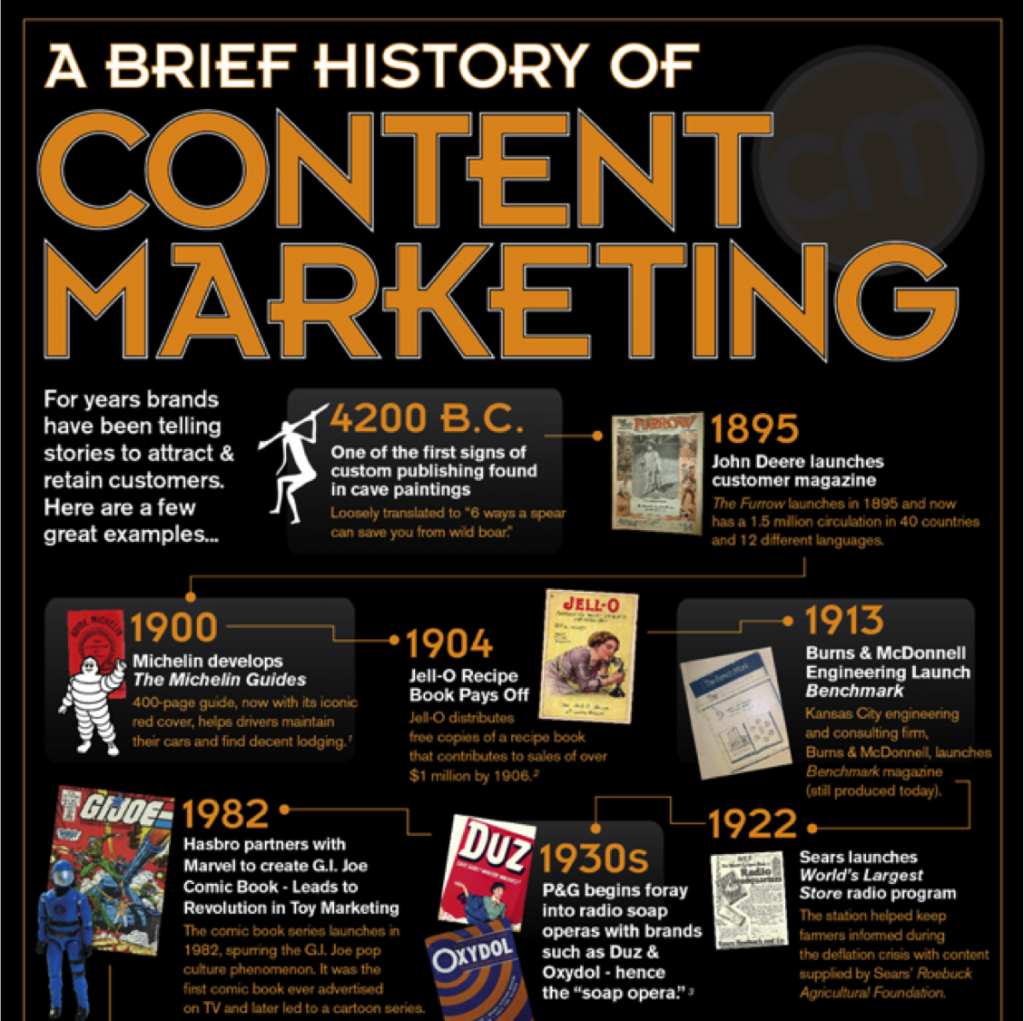
The Content Marketing Institute Presents A Brief History of Content Marketing

The History of Content Marketing

From the dawn of time people with things to sell have been using stories to attract, engage, and retain customers ala #optimize. The infographic above from the Content Marketing Institute takes us all the way through the evolution of content marketing and provides some meaningful insight into what companies have done in the past to generate results. You might learn a thing a two, plus it’s a great read.

 ”6 Start-up Tips From the World’s Biggest Tech Companies”  Every company has to start somewhere.  Famous companies such as Google, HP, and Microsoft were built on a set of core principals including creating long term customer relationships and listening to feedback.  This post provides tips from some of the largest companies in world on how to get through the start up phase of your business. Via Inc.

“38 Million Americans Visit Social Networks on Mobile Devices ‘Near Daily’ [STUDY]“ A recent study released by comScore found that 64.2 million U.S. citizens use mobile devices to access social networking and more then half of them are visiting daily.  Curious to know what type of information they’re reading and sharing?  Via Mashable.

“10 Ways to Deal With Upset Customers Using Social Media”  As hard as you try there will almost without exception be negative feedback about your company.  What can separate you from the competition is the way that you handle this interaction.  Each negative comment is an opportunity to address a problem or help retain a customer who might otherwise be lost.  This article provides 10 very helpful tips on what you can do to turn a negative into a positive.  Via SocialMedia Examiner.

“The Top Reasons Customers Break Up With Brands Online”  Do you know why customers may be choosing to “break up” with your brand?  This infographic provides some very interesting statistics on why consumers choose to unsubscribe from email campaigns, “unlike” your brand on Facebook,  and stop following your company on Twitter.  Via Ragan.

“What Matters in Social Business?”  We can all agree that social business is top of mind for many marketers.  However, we need to understand what matters most in social business.  Understanding how online marketing has evolved and the role it will continue to play is key in creating a long-term sustainable strategy.  Via CMS Wire.

TopRank Team News

Ken Horst – Google’s new Latitude Leaderboards suggest gamified check-ins are coming to Google+

Google’s recent update for Google Maps for Android included a new gaming element which is tied to its “Latitude” location app.  This new update includes an overall leader board among friends and it leader boards by location.

Clearly Google has a plan to incorporate their check in service with Google+ and adding the gaming aspect is another indicator that Google is serious about fighting for this space.  Will all this be enough to steal significant market share from heavily entrenched Foresquare?  Stay tuned!  Via The Next Web.

Brian Larson – Researcher: Facebook’s 2012 Ad Sales to Top $5B

Facebook ad revenue is expected to increase by 2 billion year over year. That’s right, social media giant Facebook is expected to reach 5.1 billion in ad sales revenue in 2012, according to eMarketeter. Of that 5.1 billion, 2.6 billion is expected to come from display ad sales. Trailing close behind in display ads is Google, which eMarketer expects to draw 2.5 billion in ad sales revenue.

As Google expands its footprint, it should come as no surprise that eMarketer predicts Google will surpass Facebook in display ad sales in 2013.  Via ClickZ.

Time to Weigh In:  Have you incorporated storytelling into your content marketing strategy?  If so, what results have you seen?  How do you currently handle negative feedback online and is it working?

search engine marketing uk search engine optimisation agencies

SMX Live: Keynote with Susan Wojcicki, SVP Advertising, Google, Inc.

Live Blogging Coverage SMXBelow is live coverage of the Keynote with Susan Wojcicki, SVP Advertising, Google, Inc. panel from the SMX West conference. This coverage is provided by Barry Schwartz of RustyBrick.

Disclaimer: The coverage is brought to you in real time, using a custom live blogging tool. Feel free to ask questions or leave comments for inclusion into the live coverage. During the live event, live notes will auto-scroll with newest entries at top. After the session is complete the archive version will have the oldest entries at the top. We ask you to please excuse any typos, as these are live notes.

Now Live!   Auto-Refresh: On

Stay tuned! Live updates will begin momentarily.

local search engine optimization local search marketing services

Groupon Buys Travel Search Site Uptake Mostly For Headcount

Uptake was an ambitious travel site that never quite broke through. It used social data and sentiment analysis to try and provide better travel discovery and decision support to its users. Originally called Kango, we wrote about the site in 2008 when it relaunched as Uptake.


AllThingsD today reported that Uptake had been acquired by Groupon for something in the “teens of millions” (between $10 and $20). The company raised roughly $14 million from venture capital inventors, so it was basically a “break even” transaction. Apparently Groupon wanted the team and will integrate most of the key personnel into its Palo Alto, California office.

In 2008 Uptake sought to aggregate content from existing travel sites to provide a better, more flexible and more comprehensive travel search experience:

Co-founded by Yen Lee, who was GM of Yahoo Travel, UpTake describes itself as a “travel search and discovery site.” It’s aggregating consumer reviews and listings information from many travel sites to attempt to create a trusted destination to begin travel search. Content comes from Expedia, Fodors, goCityKids, Virtual Tourist, TripAdvisor, Citysearch and Yahoo, among others.

The site analyzes and applies sentiment analysis to the content of reviews to be able to call out attributes like “pool,” “kitchen,” “babysitting” or “oversized rooms.” It also presents ratings from third party sites side-by-side so that users can gain a consensus view of the hotel’s quality and service.

In the beginning Uptake was probably inspired by Yahoo’s ahead-of-its-time TripPlanner social travel site, which was shut down a few years ago. Co-founder Yen Lee was the GM of Yahoo Travel, as mentioned. (Somewhat ironically, Jasper Malcolmson who succeeded Lee as GM of Yahoo Travel later became the founder of deal site Bloomspot.)

Even though the Uptake site is slated to continue in the near term it will probably be shuttered ultimately. This is the all-too-common pattern with such “acqhire” transations. In addition, Groupon currently has a rudimentary travel site in Groupon Getaways (in partnership with Expendia).

When I heard about the acquisition during one of my SMX sessions earlier today my first thought was that Groupon might be evolving and doing something more creative and interesting with travel. However I thought something similar when Groupon acquired check-in site Whrrl, which was later shut down.

Travel has been a very successful vertical for Groupon and deals in general. There’s potentially a great deal more that could be done by Groupon with a bona fide travel site like Uptake. However that’s not the route that Groupon appears likely to take.

Related Topics: Groupon | Search Engines: Travel Search Engines


internet search engine optimization internet search engine placement

Meaningful SEO Metrics: 3 Ways to Approach Measuring Online Business Success #SESLondon

SEO MetricsWhat good is great content optimization and social media promotion without meaningful measurement? This session at SES London focused on three different perspectives towards measuring performance which were as relevant to any online marketing as they were to Search Engine Optimization.


In fact, that notion of “SEO is Marketing” lends really well with the trend a lot of people are talking about in the online marketing industry. Many SEOs are building up more strategic skills and approaching optimization more holistically. Ironically, this is my topic next week at Search Congress in Barcelona so this session proved to be quite useful for a more holistic online marketing measurement perspective (with a SEO slant).

For this session at SES London, moderation duties were handled by Jon Meyer from Yahoo! and included Chris Boggs from Rosetta (Publics) who is also President of SEMPO, Kevin Gibbons, SEO Director at SEOptimise and Will Critchlow from Distilled.

Things started off with Chris Boggs:

For SEO, there are 3 primary areas to measure on:

  1. Technical: Pages indexed, server response, competitors.
  2. On-Site: Think of content holistically, not just HTML. Images, video and applications.
  3. Off-Site: Promotion and link building as well as social metrics.

The basics of SEO metrics involve traffic, such as brand vs. non-brand keyword referrers. Basics also involve conversions, which might include things like sales, leads, downloads, page views, etc – whatever outcomes are important to you.

Keep in mind to track everything at a macro level but make sure you’re also tracking at a business unit and category level. Why and when you should measure depends on your perspective:

Reactive Measurement:

  • Loss of rankings and traffic
  • Loss of onsite conversions
  • Loss of phone calls, emails, etc

Proactive Measurement/Monitoring:

  • A new competitor seems to be up in search visibility
  • Algorithm update
  • Industry shift
  • Monthly reporting

Vertical SEO Measurement Nuances:

  1. Retail: Measure the quantity/variety of unique keywords being used to enter via organic search.
  2. Financial Services: Understand the interactions with Branch Locator or other destination pages. Measure user path through the site once entered through search to determine if they’re “qualified”.
  3. B2B: Understand the value of search positioning for part and model numbers as well as downstream traffic to other organizational domains.
  4. Healthcare and Pharmaceutical: Be aware of surfacing metrics which will help legal and brand marketers understand the need for deeper keyword optimization.

Measuring the Halo:

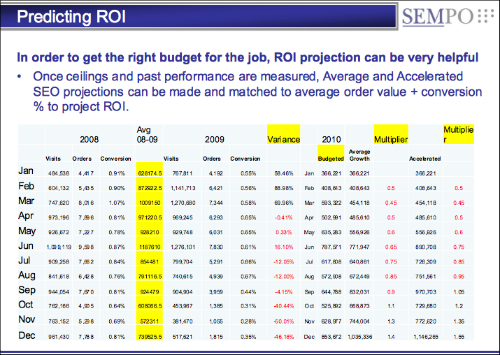
Predicting SEO Performance

Calculating future SEO performance is a matter of art meeting science and as with many things related to SEO, there are many variables at play as well as unknowns. Chris shared a model for predicting SEO performance based on past data, a number of assumptions on market data and expectations.  Chris talks about this in more detail in this Search Engine Watch article than I was able to capture here (he talks fast!).

Next up is Kevin Gibbons who asked: How do you measure your key business goals related to SEO?

Think about bigger picture business metrics, not just tactical KPIs like traffic and rankings. Business leaders are about the performance of the company and things like total revenue, revenue per order, profit, revenue from online channels and overall market share. SEO can have a tremendous impact on these larger business success metrics.

SEO goals are usually:

  • Organic search traffic
  • Non branded traffic
  • Search rankings

Shouldn’t overall business goals align with SEO goals? Do rankings equal business success? Maybe, but you need to figure out how. It’s important to focus on client goals – revenue and profit. But how?

Business decision makers understand the ROI of PPC so use that model. With an understanding of traffic, conversions and keyword performance, marketers can scale up or down accordingly. Why don’t SEOs measure that way?

With a PPC measurement model, you know how much you’re spending on SEO and you know how much traffic you’re getting as well as conversion information. Apply that perspective and you’ll be closer to providing more meaningful metrics at a business level using terms and data executives understand.

7 Step Process to Making SEO Metrics More Meaningful for Business Success Measurement

  1. Analyze organic traffic as a potential PPC media spend cost.
  2. How much is that traffic worth to your business? What is the revenue value of SEO? Order value and conversion rate will help you estimate the value of your SEO traffic.
  3. Competitor Gap Analysis: How much is there to make up?
  4. Market Share Analysis: What query volume is there for broad phrases? What is the average cost per click for those phrases? What will help you estimate the comparable advertising value?
  5. Make it actionable: Viewing SEO as a PPC model, look beyond clicks to see impressions, where if you improved ranking of average position, you could improve the quantity of traffic.
  6. Break down SEO campaigns into a more scalable and measurable project. Focus on specific activities to break down the activity on certain categories or areas of topical focus. Then shift to a different category the next month. Do a benchmark measurement and see what the impact is on ranking, traffic and revenue.
  7. Forecast results: When things are broken down into a more granular level it should be easier to forecast the effect.

The end result should be more measurable results and more budgets for SEO.

Takeaways:

  • Define business goals and align them with SEO goals
  • Measure SEO performance as closely as a PPC campaign
  • Break projects down into manageable actions and achieve results that are more likely and more measurable

And now, for something completely different.

something different

This image was my idea - love this expression from Monty Python

Last up is Will Critchlow who took a different and very interesting approach towards SEO metrics. Actually, it was performance measurement that could be applied to any agency activity, not just SEO. Will’s focus was on metrics that matter to make your projects run better. Basically, Project Management with a SEO spin.

Step 1 is to have a plan. Whatever it is you’re involved with, make sure there is a plan and get leadership sign off (buy in) to it.

With most metrics, you’re measuring quantity of output but what happens when things go wrong? The metrics that matter are the inputs.

Activity: What have you done? The first question to ask SEO practitioners is about what have they been doing. How much time have they spent on it? Hours spent, emails sent, etc.

With tasks, break down the component parts and evaluate the performance on execution of those tasks. Put into place KPIs, and performance measures that indicate progress towards achieving the goals outlined in the plan.

Output: How’s the plan going? Think of it like a business plan. There are assumptions towards progress made in a plan. Midway through the project you should check progress towards the goal. Break down component parts and document progress. Break down appropriate tasks into efforts and successes. Determine the rate of success per task or activity.

Results: How much money have we made? If you start measuring revenue from the start, you’re doomed to fail. It’s important to measure inputs first. Identify roadblocks regardless of who it is.

Problem discovery normally happens when things are going wrong. It’s better to identify problems before things go wrong. Do that by focusing on inputs vs. just outputs. Quality and performance of inputs will reveal problems before they get to outputs in a significant way – when they can still be fixed.

Focus on leading indicators for success or failure. Identify the reasonable measures of progress towards the plan, knowing it can take a while to see the effect of qualitative SEO implementation. Look at soft metrics like, “do people like it” and social engagement metrics before SEO momentum is achieved for traffic and conversions.

Activity – Most important. Have we done the things we need to do.
Output – Is the stuff we’re doing making progress towards the plan?
Results – Are your efforts achieving revenue performance goals?

SEO Metrics SES London

Probably the longest room for a conference session I've ever been in. This was from 2/3 back.

This was a very interesting and diverse session which made it more valuable. What are some of your key approaches towards better SEO measurement? What roadblocks have you overcome in terms of forecasting, business level measurement and project management?

natural search engine optimization off page search engine optimization

Tuesday, 28 February 2012

Microsoft And Nokia Unify Maps On PC, Mobile

Microsoft and Nokia announced the fruit of their recent mapping collaboration today. Each company has a blog post describing what’s changed and improved (Bing, Nokia). The effort comes out of the companies’ strategic partnership in mobile. As part of that arrangement Microsoft is relying heavily on the Nokia-Navteq mapping and data infrastructure. Nokia for its part has made Ovi Maps much more Bing-like in appearance.

Essentially the UI has been simplified, colors have been muted and there’s an improved “visual hierarchy” at each level of zoom. It’s challenging for me to specifically tell what’s new on Bing Maps, however. Here’s more from a Microsoft spokesperson:

This week, as an extension of the Microsoft-Nokia partnership, a new joint map design will begin rolling out across Bing Maps, Nokia Maps and Windows Phones. This unified map style will feature key elements from Microsoft’s metro design, including strong typography, improved readability and a clean user interface to help people find and use mapping information more quickly. As part of the update, Bing Maps will also be improving its global mapping coverage in countries such as Egypt, Israel, Venezuela and many others, refreshing the maps with new roads, subdivisions and additional refinements.

The new mapping UI and features will appear on both companies’ PC and mobile sites. While there are still UI and user experience differences between Bing Maps and Nokia Ovi Maps, the look and feel is very close.

Below is comparison of maps on Bing and Nokia in response to the query “San Jose Convention Center,” where I am now at SMX West:

Bing Maps

Nokia Maps

For comparison purposes, here are Yahoo Maps (also powered by Nokia) and Google Maps results for the same query.

Yahoo Maps

Google Maps

The new Bing-Nokia maps are less visually cluttered than Google or Yahoo Maps. But some may equally characterize that as a “washed out” quality. Indeed, the assessment of the new mapping UI for Bing and Nokia will depend on your subjective aesthetic preferences.

Whose maps do you prefer?

Related Entries

Related Topics: Google: Maps & Local | Microsoft: Bing Maps & Local | Microsoft: Bing Mobile | Search Engines: Maps & Local Search Engines | Search Engines: Mobile Search Engines | Yahoo: Maps & Local


how to promote your website how to search engine optimization

Google Plus: Average User Spends Only 3 Minutes Per Month!

google-plus-registrationDuring a conference call with Google investors in late January, Google CEO Larry Page announced that Google+ had surpassed 90 million users. Although the growth rate for the social network has been phenomenal, Google has unnaturally propelled its growth by automatically creating Google+ accounts for all new Google users. In addition, the company has refused to provide data regarding the number of active users or the amount of time users are spending on the new social network.

Now, according to a recent comScore report, information has been released that suggests Google+ users are only averaging a total of 3 minutes per month on the site. This data has caused The Wall Street Journal to call Google’s networking site a “virtual ghost town.” Below is comScore’s breakdown regarding the average number of minutes users spend on each of the major social networking sites:

Facebook: 405 minutes
Pinterest/Tumblr: 98 minutes
Twitter: 21 minutes
LinkedIn: 17
MySpace: 8
Google+: 3

The comSocre data above only includes desktop users and does not include mobile users or client services such as Tweetdeck. Since mobile usage is particularly high among both Facebook and Twitter users, the actual number of minutes per user for those two social networks may have been much higher.

David Cohen, an executive vice president that specializes in media buying for Universial McCann, said the lack of engagement on Google+ could indicate a future monetization problem for the social network:

“Google+ does not have the same degree of vibrancy that Facebook, Twitter or even Pinterest has at the moment. Without active engagement, it will not be as attractive to advertisers.”

Even though Bradley Horowitz, Google’s vice president of product management, would not share specifics regarding the time users spend on site, he indicated that Google+ is a destination site and that the metrics are “extremely hard for any third party to measure.” In addition, he said that the Google+ network is experiencing satisfactory growth in every area that Google measures. A Google spokeswoman told reporters that the comScore data was much lower than Google’s internal metrics.

[Sources Include: The Wall Street Journal and Marketing Land]

search engine marketing firms search engine marketing jobs

A New Series Starts at SEJ Tomorrow, Client HORROR Stories!

I was thinking the other day about all things I have learned after dealing with clients for the last 7 years. Some things can only be learned by dealing with real life experiences. How you run your business and the rules you put in place for your clients is often, unfortunately, learned from bad experiences (or if you are lucky, advice from your peers).


I contacted some folks about possibly sharing some experiences and to share with us what they (or the client) had learned from that experience.

Tomorrow our first “horror” post will be by Dana Lookadoo of Yo! Yo! SEO. So check back tomorrow at 9AM.

The main goal is to share with other SEO’s, marketers, web designers etc., lessons we have learned so maybe you can avoid some of the “horror” we have had to face. Some may say that horror is a strong word, but it really isn’t. The amount of stressed caused by difficult clients and moronic things that clients do is really astounding, and completely unhealthy.

If you don’t have rules in place for clients you could be setting your self up for some major misery and more importantly lost money. Time wasted is money lost! You have to make sure you have not lost money due to client laziness, indecisiveness, lack of organization, ignorance and lack of dedication to the completion of a project.

I hope that this series will help many of you avoid stress, lost money and horror stories of your own.

If you are interested in contributing to this series please email me or contact me on Twitter.

outsource search engine optimization paid search engine marketing

How To Best Optimize Your Mobile Site For SEO

Last week my colleague, Michael Martin presented Mongoose Metrics data that demonstrates that less than 10% of you are mobile ready in 2012.  He also presented some pretty compelling reasons for going mobile in 2012, including the Compuware study that 57% of customers would not recommend a business with a bad mobile site, and 40% would actually even go to a competitor with a better mobile experience.

If you’re a regular reader of this column and you don’t have a mobile experience, you are in the majority of site owners; but you’re also way behind and may not be able to catch up if you wait much longer.

So are you ready? Let’s talk about the ideal set up for your mobile site for SEO purposes.

There are cheaper, easier solutions, but this is the one that I would recommend to webmasters looking not just for a mobile friendly solution, but something that’s truly optimized to bring in traffic from mobile searchers.

If you want to build a mobile site in a way that will increase your organic search engine traffic, this is how to do it.

1. Make It Truly Mobile

Before you even think about subdomain options, you better know your mobile user: the person who you’re building this for who will ultimately make it a success or failure.

What are they looking for and why? Use the AdWords keyword tool to get mobile volumes and desktop volumes for keywords related to your brand, and to your products and services, and then find the mobile percent of total volume, or the mobile ratio, as Sherwood Stranieri put it. This gives you a sense of what concepts and keywords overindex with smartphone and mobile searchers, and it will help you build more than a desktop experience.

For example, for Walgreens, it’s clear from their brand keywords that index high among mobile searchers that the majority of searchers are looking for a Walgreens near them. It’s clear from the volume of queries where more than 30% of the total volume is mobile (smartphone and feature phone):

And it’s clear from a long tail analysis of the same list:

These are highly qualified searchers, as they’re very likely to convert offline, so why not make it as easy for them as possible?

Now that we know what our mobile users want, we can design the mobile site so that it provides those things with ease. And this will differ for all businesses, but it’s likely to be different from how your desktop website is structured.

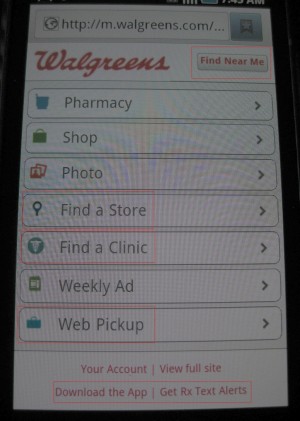
Walgreens seems to know this, as they designed their mobile website differently than their desktop website, specifically taking advantage of the unique capabilities of a mobile device.

Instead of having their mobile searcher find a site with a lot of irrelevant content crammed on to one page that’s intended for desktop users, they’ve highlighted those areas that are most relevant to the mobile user experience.

For example, instead of doing nothing with their site and hoping that a mobile searcher finds the sections they’re looking for (which I’ve highlighted in red in the second image):

Walgreens has presented a simplified version of the home page that highlights those areas of the site that are most relevant to the mobile user experience:

When you hit the “find near me” button, it uses the phone’s GPS to find the locations closest to you, taking advantage of the specific functionality of mobile browsers rather than completely transcoding the desktop site with desktop functionality to look good on mobile browsers (i.e. responsive design).

Walgreens.com isn’t the paragon of mobile SEO, unfortunately, as they’ve done a lot of things wrong when it comes to the findability of their mobile site. With the design they really should have included a small keyword-rich text box that conveys the relevance of the page to users and search engines, as there’s not a lot of text or keywords on the page to help search engines understand that it’s relevant for what search engine users are looking for.

For some brands, there may also be concepts and keywords that aren’t included in the desktop site that need to be linked to from the homepage.

I’m guessing this is because the page was designed with users rather than SEO in mind, as someone hired the non-search-friendly mobile platform Usablenet to design the site and disallowed it in the robots.txt file so that it only appears in search engines when you put in the navigational keyword [m walgreens com].

They also promote the app over the mobile site by sending the searcher to a splash page first, which isn’t good for users or search engines.

Nonetheless, like State Farm and too few other companies, they did build a separate mobile user experience rather than used stylesheets to serve a formatted desktop experience, which is the first big step to getting a search-optimized mobile site.

2. Create A Hybrid Of Mobile-Optimized & Mobile-Friendly Content

Once you’ve settled on the design and site architecture, you need to determine the best way to host your mobile site. Though there are many opinions on the matter, the best solution is to host your mobile homepage and mobile-only pages at m.domain.com subdomain or /m subfolder.

For all other pages with content that won’t change from desktop to mobile, it’s perfectly acceptable to keep them at the same URL as your desktop and simply reformat them for mobile user agents. Redirects work fine too, but the best practice for transcoded desktop URLs is currently to add canonical tags to pass the link equity back to desktop pages.

For mobile only pages that are not strict duplicates, canonical tags are unnecessary, and could make your most valuable pages invisible to searchers.

3. Redirect Appropriately

For mobile-only content, you’ll need to set up the proper redirects. My colleague Cindy Krum has a handy tool for PHP and .NET redirects that makes it easy for novices to set up mobile redirects.

When Googlebot comes by, serve it your desktop content; but when her sisters Googlebot mobile and smartphone Googlebot arrive, give them your feature phone site (if you have one) and your smartphone site, respectively.

If you have a tablet site, by all means serve it to tablet searchers instead of your desktop or smartphone site, but there currently is no tablet Googlebot to receive your tablet site.

If you don’t have a tablet site, serve your tablet searchers desktop content, as research shows that’s what they respond to best. Just make sure you’ve removed all traces of Flash before serving it up to the iPad or other tablets that don’t support Flash.

4. Don’t Forget the Images!

It has been a long time since mobile SEO was about optimizing WAP sites, and in the near future we may be optimizing for a literal pair of Google Goggles, with a Terminator-like overlay that searches for more information on the things around us, just by analyzing images and comparing them to Google’s image and Google Goggles image database.

SEOs can prepare for this brave new world today by ensuring images are optimized for mobile searchers.

5. Analyze & Optimize

Sure, there are mobile SEO best practices beyond this, but best practices only go so far. If you want to retain the edge that optimizing your site in this way gives you, you can’t just set it and forget it.

Given how rapidly this practice is changing, and how much it has changed in the last five or six years, mobile SEO requires regularly looking to your web analytics and to columns like those in the Mobile Search section in Search Engine Land in order to stay optimized.

There are many ways to go mobile, and many of them will actually hurt your visibility among mobile searchers. If you create mobile content when appropriate, redirect appropriately, optimize your images for mobile searchers, and analyze your site for new opportunities, there won’t be many mobile webmasters who will be able to compete with you in natural search.

Opinions expressed in the article are those of the guest author and not necessarily Search Engine Land.

Related Topics: How To | How To: Mobile Marketing | Intermediate | Mobile Search | Search Engines: Mobile Search Engines | SEO: Mobile Search

online marketing company uk online marketing search engine

Video Overview Of Google Webmaster Tools

Google Webmaster ToolsDid you know the Google Developer section has an education section for Webmaster Tools at developers.google.com/webmasters?

Fili Wiese, who works at Google on ad quality, but formerly part of search quality, posted this on his Google+ page.

Here is the video followed by the transcript:

0:01 The internet is amazing.
0:03 It's easy to share anything you create with the entire world.
0:07 Like Alice.
0:08 She just opened an online store for her handmade jewelry.
0:11 But now she's wondering, can people find her site on Google?
0:15 With Google Webmaster Tools, Alice can make sure that Google
0:19 finds her store and shows it for the correct search query.
0:23 Webmaster Tools displays the errors that Google finds when
0:26 reading her site so Alice can check those errors and fix
0:29 them to make all her pages appear in search results.
0:33 Every time Alice creates a new product page, she can use
0:36 Webmaster Tool to see if other people link to it and how often
0:39 it appears in Google's search results.
0:42 She can use that data to discover the most successful
0:44 pages and products in her store, so she can focus
0:47 on that and increase traffic to her site.
0:51 Webmaster Tools also regularly checks her site for malware,
0:54 and another problems, and will even send an email if it
0:57 finds important issues.
0:59 Now Alice can be sure that everything is OK with her site
1:02 with Google Webmaster Tools.

Forum discusion at Google+.

search engine marketing tips search engine marketing tool

How Businesses can Use Facebook Timeline

For the past months, Facebook Timeline has been the talk of the town. There’s no place in the online marketing world that’s not discussing about the redesigned profile. Moreover, the new profile design is being met by both approval and objection. But come to think of it, the social network giant is just looking for ways to make their platform user-friendly.

Old Profile vs. Facebook Timeline

With the old profile, it’ll be difficult for you to see your old status update again. But with Facebook Timeline, you can comb through your entire Facebook history and see your previous posts. Moreover, you can edit what’s on your Timeline, letting you create an online scrapbook.

As of the moment, the Facebook Timeline is only available for individual users. But businesses can have their taste of the new profile design later this month, according to Mashable. Here are few ways on how brands can use the Facebook Timeline to promote their products:

Make a Trip Down Memory Lane

Brands can bring their fans on a trip down memory lane through Facebook Timeline. Post the campaign images that you used before, your old tag lines, profile images, and let the people experience nostalgia.

Post Brand Trivia

Facebook Timeline is not just about revealing your business’ entire history. You can also use it to initiate interaction with your fans. Post and share content about your key product releases or the milestones you achieved, and ask them to share what they know about it. It will make your fans feel that they’re involved with your every achievement.

Let Fans Share their Memories

See how the time went by and let your fans share their memories with you. Allow them to post old and recent photos of them, featuring your product. This will help you know the people who have been loyal to your product. Thus, you should also learn to thank them for staying all these years.

Once Facebook Timeline hits business pages, it will encourage advertisers to be creative with their campaigns. Other than creating a digital scrapbook, they can use the cover image to promote their latest product or deals. Using their artistic side is one way to promote their business using Facebook Timeline’s photo-heavy features. Bottomline: Facebook Timeline is designed to let brands manage their profile in a way that encourage interaction with their fans. And when used properly, the profile overhaul can bring more eyes to their content.

paid search engine marketing paid search engine placement

Monday, 27 February 2012

How To Best Optimize Your Mobile Site For SEO

Last week my colleague, Michael Martin presented Mongoose Metrics data that demonstrates that less than 10% of you are mobile ready in 2012.  He also presented some pretty compelling reasons for going mobile in 2012, including the Compuware study that 57% of customers would not recommend a business with a bad mobile site, and 40% would actually even go to a competitor with a better mobile experience.

If you’re a regular reader of this column and you don’t have a mobile experience, you are in the majority of site owners; but you’re also way behind and may not be able to catch up if you wait much longer.

So are you ready? Let’s talk about the ideal set up for your mobile site for SEO purposes.

There are cheaper, easier solutions, but this is the one that I would recommend to webmasters looking not just for a mobile friendly solution, but something that’s truly optimized to bring in traffic from mobile searchers.

If you want to build a mobile site in a way that will increase your organic search engine traffic, this is how to do it.

1. Make It Truly Mobile

Before you even think about subdomain options, you better know your mobile user: the person who you’re building this for who will ultimately make it a success or failure.

What are they looking for and why? Use the AdWords keyword tool to get mobile volumes and desktop volumes for keywords related to your brand, and to your products and services, and then find the mobile percent of total volume, or the mobile ratio, as Sherwood Stranieri put it. This gives you a sense of what concepts and keywords overindex with smartphone and mobile searchers, and it will help you build more than a desktop experience.

For example, for Walgreens, it’s clear from their brand keywords that index high among mobile searchers that the majority of searchers are looking for a Walgreens near them. It’s clear from the volume of queries where more than 30% of the total volume is mobile (smartphone and feature phone):

And it’s clear from a long tail analysis of the same list:

These are highly qualified searchers, as they’re very likely to convert offline, so why not make it as easy for them as possible?

Now that we know what our mobile users want, we can design the mobile site so that it provides those things with ease. And this will differ for all businesses, but it’s likely to be different from how your desktop website is structured.

Walgreens seems to know this, as they designed their mobile website differently than their desktop website, specifically taking advantage of the unique capabilities of a mobile device.

Instead of having their mobile searcher find a site with a lot of irrelevant content crammed on to one page that’s intended for desktop users, they’ve highlighted those areas that are most relevant to the mobile user experience.

For example, instead of doing nothing with their site and hoping that a mobile searcher finds the sections they’re looking for (which I’ve highlighted in red in the second image):

Walgreens has presented a simplified version of the home page that highlights those areas of the site that are most relevant to the mobile user experience:

When you hit the “find near me” button, it uses the phone’s GPS to find the locations closest to you, taking advantage of the specific functionality of mobile browsers rather than completely transcoding the desktop site with desktop functionality to look good on mobile browsers (i.e. responsive design).

Walgreens.com isn’t the paragon of mobile SEO, unfortunately, as they’ve done a lot of things wrong when it comes to the findability of their mobile site. With the design they really should have included a small keyword-rich text box that conveys the relevance of the page to users and search engines, as there’s not a lot of text or keywords on the page to help search engines understand that it’s relevant for what search engine users are looking for.

For some brands, there may also be concepts and keywords that aren’t included in the desktop site that need to be linked to from the homepage.

I’m guessing this is because the page was designed with users rather than SEO in mind, as someone hired the non-search-friendly mobile platform Usablenet to design the site and disallowed it in the robots.txt file so that it only appears in search engines when you put in the navigational keyword [m walgreens com].

They also promote the app over the mobile site by sending the searcher to a splash page first, which isn’t good for users or search engines.

Nonetheless, like State Farm and too few other companies, they did build a separate mobile user experience rather than used stylesheets to serve a formatted desktop experience, which is the first big step to getting a search-optimized mobile site.

2. Create A Hybrid Of Mobile-Optimized & Mobile-Friendly Content

Once you’ve settled on the design and site architecture, you need to determine the best way to host your mobile site. Though there are many opinions on the matter, the best solution is to host your mobile homepage and mobile-only pages at m.domain.com subdomain or /m subfolder.

For all other pages with content that won’t change from desktop to mobile, it’s perfectly acceptable to keep them at the same URL as your desktop and simply reformat them for mobile user agents. Redirects work fine too, but the best practice for transcoded desktop URLs is currently to add canonical tags to pass the link equity back to desktop pages.

For mobile only pages that are not strict duplicates, canonical tags are unnecessary, and could make your most valuable pages invisible to searchers.

3. Redirect Appropriately

For mobile-only content, you’ll need to set up the proper redirects. My colleague Cindy Krum has a handy tool for PHP and .NET redirects that makes it easy for novices to set up mobile redirects.

When Googlebot comes by, serve it your desktop content; but when her sisters Googlebot mobile and smartphone Googlebot arrive, give them your feature phone site (if you have one) and your smartphone site, respectively.

If you have a tablet site, by all means serve it to tablet searchers instead of your desktop or smartphone site, but there currently is no tablet Googlebot to receive your tablet site.

If you don’t have a tablet site, serve your tablet searchers desktop content, as research shows that’s what they respond to best. Just make sure you’ve removed all traces of Flash before serving it up to the iPad or other tablets that don’t support Flash.

4. Don’t Forget the Images!

It has been a long time since mobile SEO was about optimizing WAP sites, and in the near future we may be optimizing for a literal pair of Google Goggles, with a Terminator-like overlay that searches for more information on the things around us, just by analyzing images and comparing them to Google’s image and Google Goggles image database.

SEOs can prepare for this brave new world today by ensuring images are optimized for mobile searchers.

5. Analyze & Optimize

Sure, there are mobile SEO best practices beyond this, but best practices only go so far. If you want to retain the edge that optimizing your site in this way gives you, you can’t just set it and forget it.

Given how rapidly this practice is changing, and how much it has changed in the last five or six years, mobile SEO requires regularly looking to your web analytics and to columns like those in the Mobile Search section in Search Engine Land in order to stay optimized.

There are many ways to go mobile, and many of them will actually hurt your visibility among mobile searchers. If you create mobile content when appropriate, redirect appropriately, optimize your images for mobile searchers, and analyze your site for new opportunities, there won’t be many mobile webmasters who will be able to compete with you in natural search.

Opinions expressed in the article are those of the guest author and not necessarily Search Engine Land.

Related Topics: How To | How To: Mobile Marketing | Intermediate | Mobile Search | Search Engines: Mobile Search Engines | SEO: Mobile Search

orange county search engine optimization organic search engine marketing

How Businesses can Use Facebook Timeline

For the past months, Facebook Timeline has been the talk of the town. There’s no place in the online marketing world that’s not discussing about the redesigned profile. Moreover, the new profile design is being met by both approval and objection. But come to think of it, the social network giant is just looking for ways to make their platform user-friendly.

Old Profile vs. Facebook Timeline

With the old profile, it’ll be difficult for you to see your old status update again. But with Facebook Timeline, you can comb through your entire Facebook history and see your previous posts. Moreover, you can edit what’s on your Timeline, letting you create an online scrapbook.

As of the moment, the Facebook Timeline is only available for individual users. But businesses can have their taste of the new profile design later this month, according to Mashable. Here are few ways on how brands can use the Facebook Timeline to promote their products:

Make a Trip Down Memory Lane

Brands can bring their fans on a trip down memory lane through Facebook Timeline. Post the campaign images that you used before, your old tag lines, profile images, and let the people experience nostalgia.

Post Brand Trivia

Facebook Timeline is not just about revealing your business’ entire history. You can also use it to initiate interaction with your fans. Post and share content about your key product releases or the milestones you achieved, and ask them to share what they know about it. It will make your fans feel that they’re involved with your every achievement.

Let Fans Share their Memories

See how the time went by and let your fans share their memories with you. Allow them to post old and recent photos of them, featuring your product. This will help you know the people who have been loyal to your product. Thus, you should also learn to thank them for staying all these years.

Once Facebook Timeline hits business pages, it will encourage advertisers to be creative with their campaigns. Other than creating a digital scrapbook, they can use the cover image to promote their latest product or deals. Using their artistic side is one way to promote their business using Facebook Timeline’s photo-heavy features. Bottomline: Facebook Timeline is designed to let brands manage their profile in a way that encourage interaction with their fans. And when used properly, the profile overhaul can bring more eyes to their content.

online search engine marketing online search engine optimization

Video Overview Of Google Webmaster Tools

Google Webmaster ToolsDid you know the Google Developer section has an education section for Webmaster Tools at developers.google.com/webmasters?

Fili Wiese, who works at Google on ad quality, but formerly part of search quality, posted this on his Google+ page.

Here is the video followed by the transcript:

0:01 The internet is amazing.
0:03 It's easy to share anything you create with the entire world.
0:07 Like Alice.
0:08 She just opened an online store for her handmade jewelry.
0:11 But now she's wondering, can people find her site on Google?
0:15 With Google Webmaster Tools, Alice can make sure that Google
0:19 finds her store and shows it for the correct search query.
0:23 Webmaster Tools displays the errors that Google finds when
0:26 reading her site so Alice can check those errors and fix
0:29 them to make all her pages appear in search results.
0:33 Every time Alice creates a new product page, she can use
0:36 Webmaster Tool to see if other people link to it and how often
0:39 it appears in Google's search results.
0:42 She can use that data to discover the most successful
0:44 pages and products in her store, so she can focus
0:47 on that and increase traffic to her site.
0:51 Webmaster Tools also regularly checks her site for malware,
0:54 and another problems, and will even send an email if it
0:57 finds important issues.
0:59 Now Alice can be sure that everything is OK with her site
1:02 with Google Webmaster Tools.

Forum discusion at Google+.

search engine optimisation leeds search engine optimisation link building

Flickr Enables Users to Block Pinterest Pinning

flickr-blocks-pinterest-pinningEven though the virtual pinboard site is still in private beta, Pinterest has rapidly grown to over 13 million users. While the innovative company has experienced explosive growth and become one of the top traffic referrers worldwide, they have recently come under fire due to affiliate link-swapping and copyright infringement concerns.

To provide content producers with a way to opt-out of Pinterest, the company recently announced the addition of a “nopin” code snippet that can be placed in the head section of any webpage. Once the webmaster has installed the code snippet, a Pinterest user who tries to “pin” content from that webpage will see the following message:

“This site doesn’t allow pinning to Pinterest. Please contact the owner with any questions. Thanks for visiting!”

The code snippet, which was created to provide content publishers and individuals a way to easily opt-out of the popular site, will prevent Pinterest’s 13 million users from “pinning” the content.

Now, Flickr has implemented a site-wide update that allows users to easily install the “nopin” code by simply changing their Privacy Settings to no sharing. However, as long as the content owner allows sharing, Pinterest users can still pin public images. Since the Yahoo-owned photo-sharing site is the third largest content sources for Pinterest, this recent change will likely affect a large percentage of Pinterest’s user base.

A Flickr representative said the following of implementing the “nopin” code:

“Flickr takes privacy and content ownership very seriously and is committed to continue to build features that protect members’ photos and videos. Flickr has implemented the tag and it appears on all non-public/non-safe pages, as well as when a member has disabled sharing of their Flickr content. This means only content that is “safe,” “public,” and has the sharing button (e.g., also for Facebook, Twitter) enabled can be pinned to Pinterest.”

Although determined Pinterest users can easily work around the “nopin” code snippet, copyright holders can also report unwanted “pins” via the Copyright Infringement Notification form on the Pinterest site.

[Sources Include: Pinterest Blog, CNET, & VentureBeat; Image by VentureBeat]

ecommerce search engine optimisation ecommerce search engine optimization

Making an Effective Social Media Editorial Calendar

Even before the birth of the Internet and Social Media, an editorial calendar has been a handy friend for advertisers. It has helped traditional marketers effectively send out their message when promoting a product. According to a study conducted by the Dominican University of California, people who write down goals, share, and update it weekly with their friends are 33% more likely to succeed.

Nowadays, an editorial calendar is also used for publishing web content, company press releases, blog posts, and online news. If you want an effective online marketing campaign, follow the tips below to make an editorial calendar.

Setting and Achieving Your Goals

You start by writing down your goals. Begin with the big picture by noting your ultimate goal for the year. After that, write your quarterly, monthly, weekly and daily objectives that you want to accomplish to achieve your ultimate goal. Just remember to take baby steps when reaching your target.

Pick a Theme

It also helps if you have a particular theme or topic for every month. Choose a broad topic that’s related to your products, and break it down into sub-topics. Write relevant content for your sub-topics, and spread your posts for the whole month. This will help you focus on a monthly product that you want to promote.

Accommodate New Social Media Channels

As the Internet grows, so does social media network. Established networking sites will continue to evolve, while new platforms will emerge. Depending on how these channels help you send your message, learn to adapt to various social media network.

Moreover, mobile marketing is also making itself known. Find ways on how you can reach your target market through their mobile devices. Bring in creative ways on how you can promote your business through mobile marketing.

Share Your Editorial Calendar

The editorial calendar was not designed to be a top secret document. Again, people who write down and share their goals with their friends are 33% more likely to succeed. While you don’t need to divulge everything, the idea is to share and collaborate with a group of writers, editors, researchers, SEO practitioners, sales reps, marketers and many more. That way, you’ll have an idea on how you can improve your editorial calendar.

Writing an editorial calendar reminds you of your business goal that you must achieve. Other than that, it tells you where your plans are leading and your executions’ current standing. Hence, an editorial calendar is an effective tool to plan and execute a successful online marketing campaign.

affordable search engine optimization services affordable search engine placement

Google Images Adds Related Image Previews

Peter Linsley, Google Image Search product manager, announced Google Images is rolling out a new feature to make the related search results more visually helpful.

In this new rollout, you will be able to hover your mouse over the related search query and see the first thing images that would show up for that related search, without actually clicking on the related image search. I don't see it yet, but here is a picture from the Google blog:

Google Image Image Preview

This is a nice little feature that I will find handy in the future.

Google said they are rolling it globally over the "next few weeks."

Forum discussion at Google Web Search Help.

online marketing company uk online marketing search engine

Sunday, 26 February 2012

Google Panda Now A Year Old But Only 13% Fully Recovered

Google Panda BirthdayToday is the one year anniversary of when Google released one of the most talked about algorithm updates ever - the Google Panda update.

Here is the history of the update thus far:

Past Panda Updates:

87% Effected Still Not Fully Recovered:

Earlier this month, I ran a new Panda poll asking Did You Recover From Panda? The responses are in and only 13% said they fully recovered, while 87% said they are still suffering from the Panda update. Put another way, 29% said they recovered a little but still are not at levels of pre-Panda Google referrals but 58% said they have not recovered at all!

Google Panda Poll

This number is higher when compared to our 2011 survey which showd 85% haven't fully recovered. Although on this study, I removed the not applicables, so if you include them the results are closer to 70% of those who didn't fully recover. But those who were not impacted have nothing to recover from, so 87% makes more sense.

Help:

There is still that ongoing help thread at Google Webmaster Help, it currently has over 8,500 posts in it. But, clearly, for many, they have no clue how to get their sites out of the Panda mess they are in.

We have written over 80 stories in the past year on Panda alone. I won't list them all here, but you can get them by seeing our Panda category.

Search Quality Improve:

Many SEOs will say now, but overall, based on the nasty reviews Google was getting from the core public prior to Panda, I have to say Google accomplished what they wanted with search quality by implementing Panda.

Will it last - no. But I am sure 2012 will have its own Panda. Embrase yourselves SEOs.

Panda Infographic:

Search Engine Land and BlueGlass put together a nice infographic on the year of Panda:

The Google Panda Update, One Year Later

Forum discussion continued at Google Webmaster Help.

Image credit to ShutterStock for Panda birthday.

search engine marketing software search engine marketing solution

45 SEO and Social Media Tools #SESLondon

Social SEO Tools

I really lucked out after moderating the morning session at SES London on Social Media Tools by joining the SEO Tools of the Trade session that followed. Both sessions had great speakers and I’ve decided to combine my notes for both into one post about social media automation tools and SEO tools.

The sources for the SEO tool recommendations include:  Richard Baxter of SEOGadget, Dave Naylor from Bronco, and Neil Walker from Just Search. The social media tool recommendations came from Andrew Girdwood from bigmouthmedia, Paul Madden from Automica and Marcus Tober from SearchMetrics.

Before I get into the list of tools, I feel compelled to share a quote that I’ve often used to give people context for tool use, since it’s so important to use them for scale, efficiency and to gain a competitive advantage:

“Tools are only as effective as the expertise of the person using them.”

I think that’s an important perspective, because some online marketers use a small handful of tools but their expertise is very deep. Therefore, they get a tremendous amount of productivity from them. Others use many, many tools without deep expertise in anyone area and as a result, effectiveness may be lacking. Once you find a handful of tools that work for you, get really, really good at using them. At the same time, always be open to trying new tools as they come along.

Ok, let’s start off with SEO Tools:

  1. RedFly GoogleGlobal Firefox & Chrome Extension – See SERPs in other countries
  2. Netcraft - Hosting, DNS, site uptime and many other features
  3. MajesticSEO – Link tracking, research and analysis. Export links by country code (TopRank uses MajesticSEO
  4. Copyscape – Find copies of your content elsewhere on the web to avoid duplicate content issues
  5. Google Webmaster Tools – How does Googlebot interact with your website. Check for crawl errors that could affect inclusion and ranking of your content
  6. Firebug – Firefox extension for reviewing code, look for hidden text issues that could affect search engine penalties
  7.  Google Page Speed - Check the load time of your web pages. Slow loading pages are not your friend and certainly nothing Google will reward you for
  8. Pingdom – Monitor uptime of your website. If your website is down neither customers or search engines can get to it.
  9. Xenu Linksleuth or Screaming Frog to spider your website
  10. Open Site Explorer – Download data and segment anchor text for identifying good/bad inbound links
  11. KISSinsights – Find sales objections and test them with a super short survey
  12. Fivesecondtest – Show an image and see what people think of it. Analyzes most prominent areas of your design
  13. Google Website Optimizer - A/B test your page designs
  14. Google Adwords Keyword Tool – Official keyword research tool from Google
  15. Spyfu – Perform competitive PPC and SEO keyword research
  16. Alexa - Wide range of traffic and keyword information about websites
  17. SEMRush – Get competitive SEO and PPC keyword information on websites found on Google.com and many other country domains
  18. KeywordSpy - Keyword research tool
  19. Wordtracker - Keyword research tool
  20. Wordstream – Keyword research tool
  21. Keyword Discovery – Keyword research tool
  22. Socialmention – Social search tool allows you to download to csv file of social keywords and influences that you can pivot to see what what kinds of mentions are you getting, on what kinds of social media sites and how it compares to the competition.
  23. Analytics SEO – page load time, pages indexed, ranking overview, reveal potential keywords, next opportunity keywords, reporting.
  24. Sistrix toolbox – Tracks PageRank over time, ranking, position, search volume, traffic index
  25. Searchmetrics Essentials - Suite of SEO and social media tracking tools
  26. GTmetrix - Compare multiple sites for their page download speed
  27. Link Research Tools – Link research and profiling tools
  28. Keyword Density - DaveN tool providing a wide variety of data points about a website according to a specific keyword phrases
  29. maxmind – Geographic ip detection down to the city level
  30. wipmania – Geographic ip location tool

Social Media Automation Tools (Some are a bit Grayhat SEO)

  1. Evri – Social content aggregator
  2. Trapit – Topical news aggregator that leans your preferences with AI
  3. Strawberryjam – Shows the links your social network shares the most
  4. ifttt – Rules based automation of actions through social channels/media sites
  5. Paper.li – Crawls links contained within RSS feeds, Twitter lists you supply and creates an online newspaper that auto-tweets the most popular twitter handles that share
  6. Pearltrees.com – Tool for aggregating content and sharing content with a rich visual interface
  7. Tweetguru Multi – DM up to 12 people on Twitter at the same time
  8. RSS Graffiti - Pull in RSS data feeds into a Facebook page automatically
  9. Tweetadder – Auto follows people on Twitter (um, kinda spammy no?)
  10. Socialoomph – Schedule social content and status updates (Twitter and Facebook)
  11. dlvr.it - Takes a RSS feed, filters content based on rules and publishes to Twitter, Facebook and other social channels
  12. Odesk – Not a tool but a resource to outsource redundant tasks. Use for research, writing small content, etc.
  13. Socialenhancer – In beta: Auto reply to tweets by keyword. Export followers for analysis
  14. Tweetdeck – Twitter management tool
  15. Hootsuite – Twitter, Facebook and other social channels management tool
SEO Tools

Richard Baxter, Dave Naylor, Neil Walker

There you go. I hope you find these tools useful. Some are quite old and some are new. Some are a bit iffy in terms of being more mechanical than meaningful for social engagement. Take care when checking them out. Tools can be a bit of a time suck so think about what your goals are, what tasks do you want to achieve. Look at these sites if you have time or ask other SEO and Social SEO professionals about them to decide what you want to try or test out.

What are some of your favorite SEO tools? What tools do you use to improve efficiency and automate redundant tasks when it comes to Social SEO actions? Would you like to see us do more reviews of tools?

search engine marketing optimisation search engine marketing optimization

Online Marketing News: Facts Tell & Stories Sell, Start-up Tips from Tech Giants, Mobile Skyrockets, Breaking Up With Customers

The Content Marketing Institute Presents A Brief History of Content Marketing

The History of Content Marketing

From the dawn of time people with things to sell have been using stories to attract, engage, and retain customers ala #optimize. The infographic above from the Content Marketing Institute takes us all the way through the evolution of content marketing and provides some meaningful insight into what companies have done in the past to generate results. You might learn a thing a two, plus it’s a great read.

 ”6 Start-up Tips From the World’s Biggest Tech Companies”  Every company has to start somewhere.  Famous companies such as Google, HP, and Microsoft were built on a set of core principals including creating long term customer relationships and listening to feedback.  This post provides tips from some of the largest companies in world on how to get through the start up phase of your business. Via Inc.

“38 Million Americans Visit Social Networks on Mobile Devices ‘Near Daily’ [STUDY]“ A recent study released by comScore found that 64.2 million U.S. citizens use mobile devices to access social networking and more then half of them are visiting daily.  Curious to know what type of information they’re reading and sharing?  Via Mashable.

“10 Ways to Deal With Upset Customers Using Social Media”  As hard as you try there will almost without exception be negative feedback about your company.  What can separate you from the competition is the way that you handle this interaction.  Each negative comment is an opportunity to address a problem or help retain a customer who might otherwise be lost.  This article provides 10 very helpful tips on what you can do to turn a negative into a positive.  Via SocialMedia Examiner.

“The Top Reasons Customers Break Up With Brands Online”  Do you know why customers may be choosing to “break up” with your brand?  This infographic provides some very interesting statistics on why consumers choose to unsubscribe from email campaigns, “unlike” your brand on Facebook,  and stop following your company on Twitter.  Via Ragan.

“What Matters in Social Business?”  We can all agree that social business is top of mind for many marketers.  However, we need to understand what matters most in social business.  Understanding how online marketing has evolved and the role it will continue to play is key in creating a long-term sustainable strategy.  Via CMS Wire.

TopRank Team News

Ken Horst – Google’s new Latitude Leaderboards suggest gamified check-ins are coming to Google+

Google’s recent update for Google Maps for Android included a new gaming element which is tied to its “Latitude” location app.  This new update includes an overall leader board among friends and it leader boards by location.

Clearly Google has a plan to incorporate their check in service with Google+ and adding the gaming aspect is another indicator that Google is serious about fighting for this space.  Will all this be enough to steal significant market share from heavily entrenched Foresquare?  Stay tuned!  Via The Next Web.

Brian Larson – Researcher: Facebook’s 2012 Ad Sales to Top $5B

Facebook ad revenue is expected to increase by 2 billion year over year. That’s right, social media giant Facebook is expected to reach 5.1 billion in ad sales revenue in 2012, according to eMarketeter. Of that 5.1 billion, 2.6 billion is expected to come from display ad sales. Trailing close behind in display ads is Google, which eMarketer expects to draw 2.5 billion in ad sales revenue.

As Google expands its footprint, it should come as no surprise that eMarketer predicts Google will surpass Facebook in display ad sales in 2013.  Via ClickZ.

Time to Weigh In:  Have you incorporated storytelling into your content marketing strategy?  If so, what results have you seen?  How do you currently handle negative feedback online and is it working?

marketing online seo services marketing search engine optimization