SPONSORS

Friday, 31 August 2012

New iOS 6 App Store Search Results Look Like Chomp

Earlier this year Apple acquired Chomp a site and app dedicated to app search and discovery. That purchase was a signal that Apple was going to revamp its app store. That overhaul has apparently happened in iOS 6, which will become available to the public later this year.

Some developers are now seeing new-look app search results (see video below) that essentially mirror the “card” layout of Chomp, which is still operating as a stand-alone site and app. However, since the Apple acquisition, Chomp is no longer supporting Android.

Here’s a current screenshot from Chomp:

Here’s a screen from the 9to5Mac video below:

There are additional minor changes coming as well. However the focus is on better app search and discovery, which has become an increasing challenge for both consumers and developers as the number of apps has mushroomed to over 500,000.

According to Nielsen, app store search is the most common way of discovering apps after “friends and family” word of mouth recommendations.

Related Entries

search engine optimisation marketing search engine optimisation newcastle

Google Burning Man Doodle: First Google Doodle 14 Years Ago

First Google DoodleWe cover a lot of special search logos here, have been for several years and even covered one this morning. But did you know which was Google's first ever Doodle?

It was designed by Google's co-founders and posted on the Google home page 14 years ago yesterday, on August 30, 1998. It was a tribute to the Burning Man Festival.

Google posted this tidbit on Google+ yesterday saying:

Today happens to be a lesser-known milestone in Google history: the anniversary of the very first doodle, which our founders put up on our homepage to indicate to users that they were at the Burning Man festival. Two of our doodlers met with +The Huffington Post to talk about how doodles are conceived of and created, their favorite doodles and how they measure success by whether they get an email from mom...

You can read the Huffington Post article as well.

That is what kicked off the concept of Google Doodles, just over 14 years ago today.

Forum discussion at Google+.

search engine marketing services uk search engine marketing software

Kenshoo: Filling the Gaps That Search Marketers Desperately Need

search engine optimisation expert search engine optimisation expert uk

Free eBook: 29 Content Marketing Secrets and the Secret Agents Who Shared Them

Content Marketing Secret AgentThe world of content marketing is full of mystery and intrigue with companies leveraging every possible resource to achieve a competitive advantage.

In the fast changing world of digital marketing, no resource is more valued than the coveted “Content Marketing Secret Agent”.

These covert content operatives perform their customer segmentation, persona development and editorial planning in the dead of night while most marketers are asleep, snug in their beds. While the average content marketer dreams of page views and search engine rankings, Content Marketing Secret Agents are mapping the customer journey, crafting meaningful messages that pull prospects from awareness to measurable conversions.

Few have been able to crack the code of this elite group but if anyone could, it’s the content marketing smarties at TopRank Online Marketing. We’ve collected some of the best tips just for you.

Content Marketing

Click image to download e-book

Yes, that’s right. We’ve collected 29 of the most experienced, knowledgeable and accomplished Content Marketing Operatives to share their secrets with those of us looking for better performance and results. You may be tempted to destroy this dossier of highly valued intelligence before your competitors get to it, but you must resist that temptation.

Consumer brands like Kraft Foods, B2B brands like Intel, IBM and Cisco, industry thought leaders like Jason Falls, Ann Handley and Joe Pulizzi have come together to share one piece of content marketing advice that would send a cold war power into an equivalent state of DEFCON 2. It’s as if we assembled, James Bond, Jack Bauer, Mata Hari, Jason Bourne, Evelyn Salt and Austin Powers all in one room and managed a brain drain of their most prized confidential information.

OK, maybe not Austin Powers, but you get the idea.

We’ve tried to have a bit of fun with this “Secret Agent” shtick in this week’s series of Content Marketing Secrets interviews. We’re continuing that theme into the advice in this e-book.  We hope you enjoy the metaphor and the information which is sound and highly valuable, just like the presentations you’ll see at the 2012 Content Marketing World conference.

The Secret Agents:

  • Robert Rose, aka Agent #1
  • Ann Handley, aka Agent #2
  • Jason Falls, aka Agent #3
  • Todd Wheatland, aka Agent #4
  • Pam Didner, aka Agent #5
  • Amanda Maksymiw, aka Agent #6
  • Mark Schaefer, aka Agent #7
  • Leslie Reiser, aka Agent #8
  • Jim Kukral, aka Agent #9
  • Michael Stelzner, aka Agent #10
  • Heidi Cohen, aka Agent #11
  • Waynette Tubbs, aka Agent #12
  • Michael Brenner, aka Agent #13
  • Ahava Leibtag, aka Agent #14
  • Julie Fleischer, aka Agent #15
  • C.C. Chapman, aka Agent #16
  • Ardath Albee, aka Agent #17
  • Brian Massey, aka Agent #18
  • Sandra Zoratti, aka Agent #19
  • Chris Baggott, aka Agent #20
  • Heather Meza, aka Agent #21
  • Andrew (Drew) Davis, aka Agent #22
  • Jon Wuebben, aka Agent #23
  • Mitch Joel, aka Agent #24
  • Marcus Sheridan, aka Agent #25
  • Amy Porterfield, aka Agent #26
  • Curt Porritt, aka Agent #27
  • Lee Odden, aka Agent #28
  • Joe Pulizzi, aka Agent #42

You can download the e-book pdf file directly here: Content Marketing Secrets eBook or view all of the secrets in the embedded presentation below:

Thanks to Content Marketing World for working with us on this project and of course to Ashley Zeckman from TopRank Online Marketing for all of her help to make it happen.

What’s your best content marketing secret?

Share your content marketing secret in the comments below and you could win a free copy of Optimize: How to Attract and Engage More Customers by Integrating SEO, Social Media and Content Marketing.


search engine optimisation services search engine optimisation company

SearchCap: The Day In Search, August 30, 2012

Below is what happened in search today, as reported on Search Engine Land and from other places across the web.

From Search Engine Land:

  • Search Facebook Friends’ Photos On Bing

    Microsoft announced on the Bing Search blog that you can now search Bing to discover your friends’ photos within Facebook. If you activated the social bar within Bing and enabled Facebook to connect to Bing, then your search results in the Bing social bar may have photos from your friends’ Facebook feeds. You can also [...]

  • Webcast, Sept. 6: “How to Build Links, Get Rankings and Stay Out of Trouble”

    1 PM EDT, 10 AM PDT. Join speaker Jon Ball as he shares how to develop an effective white-hat link-building strategy. Register now!

  • At SMX East: From Schema To Authorship To The Knowledge Graph

    Schemas, authorship, the Knowledge Graph. If these markup options and ways that Google is pulling “direct answers” into its search results has your head spinning, we’ve got a solution for you: the Semantic SEO Track at our upcoming SMX East search marketing conference. The “Schema & Authorship” panel we did at our SMX Advanced show [...]

  • Only 9% Of Tech Blogs Implement Google Authorship Properly

    A study by Conductor shows only 9% of technology blogs have fully implemented the authorship, rel=author, attribute fully on their site. That is less than 1 out of every 10 blogs. This is somewhat shocking because (1) these are technology blogs that should know about the feature and (2) it is shown to increase the [...]

  • Bing Completes “Global Ortho” High Resolution Imagery Project For Continental US

    Back when Bing Maps was called Microsoft Virtual Earth (2006) the company bought Vexcel, a US Defense Department contractor that specialized in high resolution aerial photography and automated 3D image rendering. That acquisition became the basis of Bing Maps’ subsequent ambitious aerial imagery and 3D mapping efforts. Microsoft then improved upon the camera that Vexcel [...]

  • What Retailers Need To Know About The Local-Mobile Marketing Landscape

    Retailers have an array of digital marketing tactics at their disposal: email, SEO, local search, PPC, display ads, social media, etc. These are frequently combined with traditional marketing tactics such as print, direct mail and trade shows. It’s important to select the right media mix to drive profits, and that’s why I want to review [...]

  • SEO Basics: When Your Domain & Homepage Are Not The Same

    Recently, I ran an audit on 56 music industry websites and received a startling result. Sixteen sites, 28.6%, forward people from their domain name to their homepage using 302 Temporary Redirects. These sites are tossing away valuable link authority! If your domain and homepage are different, determine how the domains forward visitors to the actual [...]

  • Google Webmaster Tools Breaks Down Site Errors

    The Google Webmaster Central blog announced that the Site Errors report now is a lot more detailed and useful for webmasters. Now, the errors are broken down by each category into more specific errors. For example, if your site is not accessible to GoogleBot, Google will try to say it is because of a DNS [...]

  • Industry Survey: PPC Is Losing Ability To Generate Leads

    SEO continues to be the top lead generating channel among U.S. digital marketers, while PPC’s effectiveness as a lead gen channel is dropping significantly. B2B marketers are even saying that social media marketing is now more effective than PPC as a lead gen channel. That’s according to the 2nd annual State of Digital Marketing survey [...]

Recent Headlines From Marketing Land, Our Sister Site Dedicated To Internet Marketing:

Search News From Around The Web:

Business Issues

Local, Maps & Mobile

Link Building

SEM Industry

SEO & SEM

search engine optimisation agency search engine optimisation campaigns

Google Bike Navigation

Google Bike NavigationGoogle announced they now have biking turn by turn directions - i.e. biking navigation, for within Google Maps for Android.

The Biking Navigation is available for the US, Canada, Australia, Austria, Belgium, Denmark, Finland, the Netherlands, Norway, Sweden, Switzerland and the UK. It also shows directions elevation lab which shows elevation profile for biking and walking directions.

This update is found in the Google Maps for Android 6.11 update. It also includes some bug fixes such as HTC reboot issue and missing layers for certain devices.

You can give it a try on your Android device by updating your Google Maps app or downloading it.

Forum discussion at Google Maps Help.

how to optimize your website how to promote a website

Thursday, 30 August 2012

At SMX East: From Schema To Authorship To The Knowledge Graph

Schemas, authorship, the Knowledge Graph. If these markup options and ways that Google is pulling “direct answers” into its search results has your head spinning, we’ve got a solution for you: the Semantic SEO Track at our upcoming SMX East search marketing conference.

The “Schema & Authorship” panel we did at our SMX Advanced show earlier this year was such a big hit that we’ve expanded it into three separate sessions as well as adding a fourth to cover Google’s still relatively new Knowledge Graph.

The sessions all happen on the second day of the show, October 3, and are:

Schema 101: Why The New Meta Data Matters

Schema.org is a joint alliance between Google, Microsoft and others to provide a common foundation for microdata standards. In other words, provide trusted meta data that allow site owners to express important “facts” about their businesses that both inform searchers and build authority with search engines. This session looks at these microdata standards and how to use them to enhance the importance of your own online content.

Schema 201: Real World Markup For Success

You know semantic markup is important, but are you using it in the most effective way possible? This session features marketers that have explored and fine-tuned their approaches to microdata and other ways of expressing authority to search engines. Speakers will also offer case-study examples of how paying attention to detail has had a significantly positive impact on online visibility.

With all of the recent focus on “content is king,” many marketers overlook that there’s a much broader process involved in establishing and maintaining the all-important factor of “authority.” This comprehensive session considers the entire process of “claiming your identity,” starting with brainstorming sessions with SEO, social and content development teams, to content promotion tactics for gaining authority links. Both enterprise SEO teams as well as outside consultants will benefit from this session.

Direct Answers & The Knowledge Graph: Friend Or Foe?

We all want the best “results” from search engines, and increasingly we’re seeing “direct answers” based on “facts” search engines discover rather than the traditional ten blue links of results. For some, this is a boon, eliminating competition. For others, it’s a nightmare, sharply increasing SEO competition, often in unexpected (and to some, “unfair”) ways. How should marketers deal with the so called “knowledge graph” and the unprecedented changes it’s creating? Come to this session to hear some great forward-looking insights.

These are just some of the over 50 different sessions we have planned for SMX East. Check out the entire agenda. Early bird pricing for the show ends this week, so register soon to save the most.

search engine marketing london search engine marketing management

Google Bike Navigation

Google Bike NavigationGoogle announced they now have biking turn by turn directions - i.e. biking navigation, for within Google Maps for Android.

The Biking Navigation is available for the US, Canada, Australia, Austria, Belgium, Denmark, Finland, the Netherlands, Norway, Sweden, Switzerland and the UK. It also shows directions elevation lab which shows elevation profile for biking and walking directions.

This update is found in the Google Maps for Android 6.11 update. It also includes some bug fixes such as HTC reboot issue and missing layers for certain devices.

You can give it a try on your Android device by updating your Google Maps app or downloading it.

Forum discussion at Google Maps Help.

outsource search engine optimization paid search engine marketing

SEO Blog Feeds - What is RSS? What are Feeds?

Subscribe via Email:

Subscribe via Feed Reader:

Feed Formatting Issues?

Does your feed reader have issues with either of the above feeds? If so you can subscribe to our FeedBurner feed

What are Feeds? What is RSS?

This video does a good job describing how feeds work.

Below is similar information, in a boring textual format.

Offline Subscriptions

In the offline world we subscribe to our interests by

  • paying for magazine subscriptions
  • watching TV channels and shows that interest us at the same time each week
  • reading all books created by a favorite author

Online vs Offline

Online individuals and companies create a vast sea of content. Too much content perhaps. To keep up with all the new content every day I could visit SeoBook.com, sethgodin.typepad.com, SearchEngineLand.com, SEOMoz.org, Wolf-Howl.com, and a bunch of other great blogs and news websites.

Or, to keep myself organized, I could subscribe to feeds from all these great sites and access them all from one place. Feeds allow you to subscribe to information you find relevant and useful, and be notified when your favorite websites are updated.

Instead of needing to visit all the above websites every day you could just go to Google (Google Reader or iGoogle), My Yahoo!, or Bloglines and read all the news at any one of these sites. You do not need to visit all 3 sites to read the news. Just pick your favorite one and subscribe to a bunch of your favorite sites. If you are an avid online reader using RSS subscriptions to keep track of the news can save you hours a day.

Bonus RSS Tip

  • In addition to subscribing to top blogs you can also subscribe to RSS feeds for news topics. For example, here is a link for the Google News feed on SEO. You can subscribe to other keywords that interest you using the RSS link in the left side of a Google News search result.
  • Other information aggregators, like Google Blogsearch, also provide RSS feeds. You can use RSS feeds to track blogs that link to your site.

Want Access to the Best SEO Feed on the WWW?

Bingo. You got it here...the featured threads feed from our private forums.

Subscribe.

Gain a Competitive Advantage Today

Want more great SEO insights? Read our SEO blog to keep up with the latest search engine news, and subscribe to our SEO training program to get cutting edge tips we do not share with the general public. Our training program also offers exclusive SEO videos.

marketing online seo services marketing search engine optimization

Secrets of Content Marketing World: Agent Ardath Albee, Marketing Interactions

Ardath Albee Content Marketing Secret Agent

There is no substitute for experience in the field when it comes to covert content marketing operations. Rest assured, your competitors are employing their best to achieve a content marketing advantage and for that reason it’s essential that we tap the experience of assets that have “been there, done that” to gain our own upper hand.

Thankfully, we have a content marketing pioneer, practitioner and thought leader in Ardath Albee, CEO of Marketing Interactions, speaker and author on our side. Pay attention to her Content Marketing Secret Agent advice and you may find yourself on the right side of content marketing ROI.

You have substantial experience in business and marketing and with your current role as CEO of your company Marketing Interactions, how has your work with content as a marketing asset evolved? What do you think about all the recent buzz about content?

Since all I work on is content strategy and content marketing for B2B companies, I’ve seen a lot of evolution. There are more channels in use, more types and formats of content gaining engagement and more marketers trying in earnest to understand how to develop content that moves the needle. This year, I’m finally seeing a growth in understanding that buyer personas are a critical tool for creating the foundation for a successful content strategy. Finally and thankfully!

It used to be that B2B content had to be long form and formatted in a PDF to be considered viable by B2B marketers. Now short-form content that’s written in a business-casual style is in play very effectively—including articles, blog posts, and social media. The rise of visual content has also changed how we think about content—from videos to infographics. Interactivity is getting more attention, but is still in the very early stages from an execution standpoint.

As for the buzz around content, I like the attention the concept is getting, but I cringe at some of the misinformation being thrown around. Content marketing is not just about creating and publishing content at will. It’s a practice based on achieving business objectives through the alignment of content with customer needs.

How would you define content marketing to someone that is new to the idea?

Content marketing is the practice of delivering the right content to the right audience at the right time based on the problem they’re trying to solve and their stage in the buying process. The intention is to create a mutually beneficial business transaction. (revenue for you and problem solved for them)

Your session “Applying Company Positioning to Power Storytelling in B2B” is focused on identifying how to use stories in a way that meets the needs of customers.  What are 3 of the primary takeaways from your Content Marketing World presentation that you think are most important? 

This is not a fair question as you’re asking me to give away my presentation! But here goes:

1. Effective storytelling in marketing carries a subtle thread of your company’s distinct value that remains relevant regardless of the topic. (If it doesn’t, you’ve veered away from your “true North”) The objective is that if all identifying marks were removed (logo, company name, etc.) your brand will still be recognizable because the story you’re telling is consistent, unique, and valuable to your audience.

2. Start where the trouble is. If there’s no trouble, there’s no urgency or intention to seek change. However, it’s important to realize that doing so requires you to really know your audience. Trouble for one segment will not be perceived in the same way as trouble for another. To be successful, your content must embrace these distinctions.

3. Ensure that the stories you tell are consistent across channels and available in all the channels your audience frequents with connected pathways that enable them to explore at will.

Where do you see content fitting in with the overall digital marketing mix? Do you think content should lead or follow with most digital marketing strategies?

Considering that everything at play in the digital marketing mix needs content to work, there’s no way to separate content from the mix. Effective content always follows strategy. Period. If you don’t know what you’re trying to achieve, who you’re trying to engage, or what channel(s) you’ll use, then it’s a crap shoot whether or not you develop the appropriate content for the job.

Many companies are challenged to create new content on an extended basis. Can you provide 3 tips for managing long term, effective content creation for marketing?

Sure. It doesn’t need to be as challenging as most marketers make it. Mostly this challenge is a construct that we impose on ourselves because we get bored and think our audiences are also bored. But that’s not true if your content is addressing the trouble they’re having.

1. Embrace the Rule of 5: I usually insist on using a content asset in five different ways. This will help marketers address the channel challenge, as well as the difficulty in creating new content. What makes it easier is that while you’re doing your research, it’s much easier to create 5 assets rather than only 1 if you have the plan in advance. Think about the requirements for effective content on different channels, as well. Using content only once is inefficient and expensive.

2. Pick a problem your prospect has that your products solve and brainstorm all the ways you can address it with content. Prompts to approaches for content development could include:

  • What to do when…
  • # ways to improve…
  • How to overcome…
  • X is helping [role] succeed at…
  • # reasons to make the shift from X to Y

3. Take a look at your web analytics and select the top few content assets based on performance. Try to determine why they were more successful than others. How can you apply the format or the topic to the development of a new content asset? Think about creating an add-on (serial) piece of content that you can link together with this one. Do you have ideas for more add ons? Serializing content is a great way to extend engagement and make it easier for you to develop content over the longer term because you’re building out a “story” that your audience has already expressed interest in.

Content is both art and science with high demands on time and resources, especially for small businesses owners that wear many hats. What tools, software or services can you recommend for marketers that want to be more efficient and effective at using content to drive new business and engage customers? Can you share 3 or 4 tools that are essential?

Although I mainly work with enterprise companies, I have three recommendations that I make to every marketer who asks, regardless of company size. They may not be exactly what you’re expecting. But if you want to become more effective with content marketing and make it easier on yourself, these three will help:

1. Create buyer personas. Buyer personas, done well, are a tool that informs content strategy and keeps your content development on track and highly relevant to a select few. They increase your efficiency at creating content because you know what information the persona is looking for. And, for SMBs, personas will keep you from trying to be everything to everyone. The most important aspect of content marketing is to pick a niche and own it. “Everybody” is not your customer.

2. Invest in marketing automation. There are many marketing automation solutions with pricing that works for SMBs available. That’s my top pick for improving effectiveness with content marketing. You need to get beyond the aggregate, big picture view down to the granular insights that can really inform you about the effectiveness of your content marketing initiatives based on prospect and customer behavior. Otherwise, you’re blowing in the wind and hoping you’re right.

3. Write a blog. In my opinion, a blog is one of the best, most effective tools for content marketing. It’s a tool I use myself and is responsible for building reputation, credibility, and trust. Many of my clients work with me due to their exposure to my thoughts on my blog. It helps people get to know you, does wonders for SEO and extends your reach. You can use blog posts in nurturing programs, as extensions to topical areas on your website, to expand your social media strategy, to start discussions on LinkedIn, and in lots of other ways. A blog is especially conducive to fulfilling the Rule of 5 that I mentioned above.

The best resource for content development software tools that I can recommend at the moment is this guide, 8 Content Production Tools to Help Marketers Transform into Publishing Machines, released recently by the Content Marketing Institute. I’ve tried some of them. Each has its strong points. But what works for whom is a personal choice based on work style and need.

Content Marketing Institute’s study earlier this year mentions that most B2B companies are using content marketing tactics to grow their business. While content marketing has a high adoption rate with B2B companies, many are still having difficulty earning internal support. What advice can you offer on winning upstream executive approval for content marketing initiatives? 

Gaining executive support for content marketing requires that it be tied to business objectives. Executives don’t care about the clicks and opens that marketing measures from email campaigns. They don’t care about the traffic numbers for website visitors. They care about how marketing initiatives contribute to revenue growth and customer retention. This is another reason that I recommended marketing automation in the question above. If marketers are to prove quantifiable value, they need to be able to track and measure lead quality and pipeline momentum.

The other thing that marketers need to do is to set the appropriate expectations. Content marketing is not a sales campaign. It takes time to show demonstrable results. I have clients with projects that were constantly threatened to be discontinued in the early stages, but 6 months in, it turns out our initiatives are outperforming the other traditional campaigns in play in other divisions of the company—by huge margins. It’s really that powerful.

What’s one content marketing secret that you would like to share with Content Marketing World attendees?

Repetition is a good thing. I don’t mean publishing the same piece over and over again, but rather creating a lot of content that comes at a topic from different angles. People need to hear something 7 to 10 times before it becomes an “anchor” thought in their minds and helps them build the confidence to change.

Additionally, some angles you take will appeal to a set of your prospects but not others. Using different approaches helps to ensure that they not only see it, but engage with it based on how the approach to the topic resonates with them. I’ve written about many of the same topics for years, and most of the time when I publish something thinking that no one will care because they’ve read it before, the attention and interest is still there or higher than it was in the past.

You have exceeded our expectations Agent Albee.  We salute you.

For those attending Content Marketing World next week, hint hint, then you’ll be able to get the full Ardath Albee experience on September 5th at 11:25am with her presentation, “Applying Company Positioning to Power Storytelling in B2B”. You can also check out her blog.

Also be sure to check out the TopRank session on the future of optimization: “Optimize and Socialize for Better Content Marketing” – Sept 6 – 3:05-3:50pm (Content Creation & Optimization Track).

What’s your best content marketing secret?
Share your best content marketing secret in the comments below and we’ll pick 3 winners this week to receive a free copy of “Optimize: How to Attract and Engage More Customers by Integrating SEO, Social Media and Content Marketing”.

This is a hard act to follow, but we have an excellent Content Marketing Secret Agent coming up next: Robert Rose of Content Marketing Institute, Co-Author with Joe Pulizzi of Managing Content Marketing and Founder of Big Blue Moose.


search engine marketing companies search engine marketing company

Why Google Will Bet the Farm on Fiber … to Sell More Ads

So much has been made about Google’s entry into the Internet Service Provider (ISP) market since the announcement of Google Fiber in July. The pilot program in Kansas City, KS/MO involves delivering Internet and TV over a fiberglass connection that promises speeds up to 100 times faster than current average Internet connection speeds.

However, a brief look into the history of the company will reveal that Google’s intention isn’t mainly to gain market share in household Internet delivery. Google’s primary focus and big investment into fiber is and has always been all about online advertising dollars.

A History Lesson About Google and New Markets

In late 2008, Google introduced Chrome, a new Web browser that promised to speed up and drive innovation on the Web. At the time, the majority of tech sites were covering the differences between Chrome, Internet Explorer, and Firefox to determine which browser would dominate the market.

Only a few writers had enough foresight to point out the greater strategic move Google was making. Chrome wasn’t about browser share (at least not then). At the time, Chrome’s main goal was to force IE and Firefox to speed up their products to prevent losing users to a faster Google browser.

With that one move, Google planted the seeds for a faster Internet, where a growing number of Internet users spend an ever-increasing amount of time looking at a constantly expanding amount of content, all of which contained monetizable, clickable, and beautiful AdWords ads.

“Note that Google likes to talk about its three main efforts: search, ads, and apps,” wrote Stephen Shankland for CNET, in one of the only pieces to highlight Google’s true motivations to enter the browser market. “With Chrome, all three benefit.”

Four years ago, Google moved a level closer to its users by moving from the search engines to browser, all in the name of ads. Now it’s taking another step closer by adding Google Fiber, and again it’s in the name of speed and with the goal of increasing ad revenue.

Doubling Down on the Future of Advertising

Why does Google need an Internet that is 100 times faster than what we have today? It’s betting that the future of television, radio, and the rest of media will be facilitated by a single Internet-based connection.

As entire industries shift from traditional to digital media, Google has positioned well to become the main advertising broker for any type of media. AdWords used to be just big with the text and display ads, but just wait until all of media is running through Google and YouTube. It’s already starting.

As of right now, 48 hours of video are being uploaded onto YouTube every minute. Much of it is the Internet content vapor that is cats on treadmills and blowing things up, but YouTube is also a hotbed for quality new media experimentation.

For example, Google recently doubled its initial $100M investment in unique programming for YouTube channels for interesting publishers such as AwesomenessTV and The YOMYOMF Network, both of which boast an awesome number of subscribers and video views.

Combined with Google Fiber’s cable TV subscription service, these investments in new media will see Google acquiring more and more content inventory that it will then monetize though both greater control of existing advertising space and by creating new places to serve video ads.

Pulling a Chrome on Comcast

My original assumption is that Google Fiber is really just about advertising, but who knows? Maybe Google does want to take over the ISP and cable TV deliver space, in addition to generating more ad revenue. It learned from Chrome that it could dominate the market if it released a great product and then iterated tirelessly to cater to user needs, especially when the competition lags behind user demand.

Cable and Internet delivery is ripe for the picking.

I don’t know anyone who absolutely loves his/her Comcast service or the archaic interface through which we’re forced to consume our TV programming. It doesn’t take a branding expert to realize that Xfinity is likely at least part of an attempt to distance Comcast’s reputation for customer service from its current Internet service.

Maybe it’s about both the advertising and the media markets for Google. I wouldn’t put it past them considering its success with search, Android, and Chrome.

If one thing is certain, Comcast and others better quickly improve the speed of their Internet delivery, or Google will soon gobble up share of the ISP market just like it did with Chrome in the browser market, as it stampedes its way towards a faster Internet and ever-increasing online advertising revenues.

Josh Braaten

Josh Braaten

Rasmussen College
Josh Braaten is a Senior Online Marketer at Rasmussen College in responsible for the Inbound Marketing strategy and team. He enjoys board games, coffee, and blogging on his blogs, Big Picture Web and Content Scientists. Connect with Josh on Twitter or Google+ as +Josh Braaten.
Josh Braaten

+Josh Braaten

Josh Braaten

Latest posts by Josh Braaten (see all)

  • Why Google Will Bet the Farm on Fiber … to Sell More Ads - August 29, 2012

Google: Apollo’s Giant Leap In Computer Power Is One Small Step For Searchkind

With the Apollo moon missions on many minds, after the death this weekend of the first moonwalker, Neil Armstrong, Google has an interesting post out about how a single search uses as much computing power as consumed by the entire Apollo program.
Much as been written about how little power the Apollo flight computers had, such as the guidance computer having less than half the power of an old IBM PC XT or that our cellphones have more processing power than the on-board systems.

Google’s post on Apollo’s computer power took a much broader view. It looked at all the computers used in the Apollo program, from those in the spacecraft to mainframes used by mission control on the ground. Adding all this power up, across 11 years and 17 missions, the company concluded that a single Google search consumes more power:

It takes about the same amount of computing to answer one Google Search query as all the computing done — in flight and on the ground — for the entire Apollo program!

That’s right. According to Google, the huge computer effort involved to make all of Apollo possible these days is expended in each search for things like “Lego Alien Conquest” or “Rebecca Black” or “Adele,” all “hot” searches last year on Google.

To put it another way, each month, Google searches consume the computing power of 100 billion Apollo missions, as the company handles 100 billion searches per month. But rather than this being somehow wasteful, it’s more an expression of how much computer power has become plentiful over the years. As the company wrote:

That’s how much computing has advanced. It is easy to take this for granted, but this computing power helps make the world a better place and opens the door for amazing things to come.

search engine marketing specialists search engine marketing strategies

Wednesday, 29 August 2012

Secrets of Content Marketing World: Agent Ardath Albee, Marketing Interactions

Ardath Albee Content Marketing Secret Agent

There is no substitute for experience in the field when it comes to covert content marketing operations. Rest assured, your competitors are employing their best to achieve a content marketing advantage and for that reason it’s essential that we tap the experience of assets that have “been there, done that” to gain our own upper hand.

Thankfully, we have a content marketing pioneer, practitioner and thought leader in Ardath Albee, CEO of Marketing Interactions, speaker and author on our side. Pay attention to her Content Marketing Secret Agent advice and you may find yourself on the right side of content marketing ROI.

You have substantial experience in business and marketing and with your current role as CEO of your company Marketing Interactions, how has your work with content as a marketing asset evolved? What do you think about all the recent buzz about content?

Since all I work on is content strategy and content marketing for B2B companies, I’ve seen a lot of evolution. There are more channels in use, more types and formats of content gaining engagement and more marketers trying in earnest to understand how to develop content that moves the needle. This year, I’m finally seeing a growth in understanding that buyer personas are a critical tool for creating the foundation for a successful content strategy. Finally and thankfully!

It used to be that B2B content had to be long form and formatted in a PDF to be considered viable by B2B marketers. Now short-form content that’s written in a business-casual style is in play very effectively—including articles, blog posts, and social media. The rise of visual content has also changed how we think about content—from videos to infographics. Interactivity is getting more attention, but is still in the very early stages from an execution standpoint.

As for the buzz around content, I like the attention the concept is getting, but I cringe at some of the misinformation being thrown around. Content marketing is not just about creating and publishing content at will. It’s a practice based on achieving business objectives through the alignment of content with customer needs.

How would you define content marketing to someone that is new to the idea?

Content marketing is the practice of delivering the right content to the right audience at the right time based on the problem they’re trying to solve and their stage in the buying process. The intention is to create a mutually beneficial business transaction. (revenue for you and problem solved for them)

Your session “Applying Company Positioning to Power Storytelling in B2B” is focused on identifying how to use stories in a way that meets the needs of customers.  What are 3 of the primary takeaways from your Content Marketing World presentation that you think are most important? 

This is not a fair question as you’re asking me to give away my presentation! But here goes:

1. Effective storytelling in marketing carries a subtle thread of your company’s distinct value that remains relevant regardless of the topic. (If it doesn’t, you’ve veered away from your “true North”) The objective is that if all identifying marks were removed (logo, company name, etc.) your brand will still be recognizable because the story you’re telling is consistent, unique, and valuable to your audience.

2. Start where the trouble is. If there’s no trouble, there’s no urgency or intention to seek change. However, it’s important to realize that doing so requires you to really know your audience. Trouble for one segment will not be perceived in the same way as trouble for another. To be successful, your content must embrace these distinctions.

3. Ensure that the stories you tell are consistent across channels and available in all the channels your audience frequents with connected pathways that enable them to explore at will.

Where do you see content fitting in with the overall digital marketing mix? Do you think content should lead or follow with most digital marketing strategies?

Considering that everything at play in the digital marketing mix needs content to work, there’s no way to separate content from the mix. Effective content always follows strategy. Period. If you don’t know what you’re trying to achieve, who you’re trying to engage, or what channel(s) you’ll use, then it’s a crap shoot whether or not you develop the appropriate content for the job.

Many companies are challenged to create new content on an extended basis. Can you provide 3 tips for managing long term, effective content creation for marketing?

Sure. It doesn’t need to be as challenging as most marketers make it. Mostly this challenge is a construct that we impose on ourselves because we get bored and think our audiences are also bored. But that’s not true if your content is addressing the trouble they’re having.

1. Embrace the Rule of 5: I usually insist on using a content asset in five different ways. This will help marketers address the channel challenge, as well as the difficulty in creating new content. What makes it easier is that while you’re doing your research, it’s much easier to create 5 assets rather than only 1 if you have the plan in advance. Think about the requirements for effective content on different channels, as well. Using content only once is inefficient and expensive.

2. Pick a problem your prospect has that your products solve and brainstorm all the ways you can address it with content. Prompts to approaches for content development could include:

  • What to do when…
  • # ways to improve…
  • How to overcome…
  • X is helping [role] succeed at…
  • # reasons to make the shift from X to Y

3. Take a look at your web analytics and select the top few content assets based on performance. Try to determine why they were more successful than others. How can you apply the format or the topic to the development of a new content asset? Think about creating an add-on (serial) piece of content that you can link together with this one. Do you have ideas for more add ons? Serializing content is a great way to extend engagement and make it easier for you to develop content over the longer term because you’re building out a “story” that your audience has already expressed interest in.

Content is both art and science with high demands on time and resources, especially for small businesses owners that wear many hats. What tools, software or services can you recommend for marketers that want to be more efficient and effective at using content to drive new business and engage customers? Can you share 3 or 4 tools that are essential?

Although I mainly work with enterprise companies, I have three recommendations that I make to every marketer who asks, regardless of company size. They may not be exactly what you’re expecting. But if you want to become more effective with content marketing and make it easier on yourself, these three will help:

1. Create buyer personas. Buyer personas, done well, are a tool that informs content strategy and keeps your content development on track and highly relevant to a select few. They increase your efficiency at creating content because you know what information the persona is looking for. And, for SMBs, personas will keep you from trying to be everything to everyone. The most important aspect of content marketing is to pick a niche and own it. “Everybody” is not your customer.

2. Invest in marketing automation. There are many marketing automation solutions with pricing that works for SMBs available. That’s my top pick for improving effectiveness with content marketing. You need to get beyond the aggregate, big picture view down to the granular insights that can really inform you about the effectiveness of your content marketing initiatives based on prospect and customer behavior. Otherwise, you’re blowing in the wind and hoping you’re right.

3. Write a blog. In my opinion, a blog is one of the best, most effective tools for content marketing. It’s a tool I use myself and is responsible for building reputation, credibility, and trust. Many of my clients work with me due to their exposure to my thoughts on my blog. It helps people get to know you, does wonders for SEO and extends your reach. You can use blog posts in nurturing programs, as extensions to topical areas on your website, to expand your social media strategy, to start discussions on LinkedIn, and in lots of other ways. A blog is especially conducive to fulfilling the Rule of 5 that I mentioned above.

The best resource for content development software tools that I can recommend at the moment is this guide, 8 Content Production Tools to Help Marketers Transform into Publishing Machines, released recently by the Content Marketing Institute. I’ve tried some of them. Each has its strong points. But what works for whom is a personal choice based on work style and need.

Content Marketing Institute’s study earlier this year mentions that most B2B companies are using content marketing tactics to grow their business. While content marketing has a high adoption rate with B2B companies, many are still having difficulty earning internal support. What advice can you offer on winning upstream executive approval for content marketing initiatives? 

Gaining executive support for content marketing requires that it be tied to business objectives. Executives don’t care about the clicks and opens that marketing measures from email campaigns. They don’t care about the traffic numbers for website visitors. They care about how marketing initiatives contribute to revenue growth and customer retention. This is another reason that I recommended marketing automation in the question above. If marketers are to prove quantifiable value, they need to be able to track and measure lead quality and pipeline momentum.

The other thing that marketers need to do is to set the appropriate expectations. Content marketing is not a sales campaign. It takes time to show demonstrable results. I have clients with projects that were constantly threatened to be discontinued in the early stages, but 6 months in, it turns out our initiatives are outperforming the other traditional campaigns in play in other divisions of the company—by huge margins. It’s really that powerful.

What’s one content marketing secret that you would like to share with Content Marketing World attendees?

Repetition is a good thing. I don’t mean publishing the same piece over and over again, but rather creating a lot of content that comes at a topic from different angles. People need to hear something 7 to 10 times before it becomes an “anchor” thought in their minds and helps them build the confidence to change.

Additionally, some angles you take will appeal to a set of your prospects but not others. Using different approaches helps to ensure that they not only see it, but engage with it based on how the approach to the topic resonates with them. I’ve written about many of the same topics for years, and most of the time when I publish something thinking that no one will care because they’ve read it before, the attention and interest is still there or higher than it was in the past.

You have exceeded our expectations Agent Albee.  We salute you.

For those attending Content Marketing World next week, hint hint, then you’ll be able to get the full Ardath Albee experience on September 5th at 11:25am with her presentation, “Applying Company Positioning to Power Storytelling in B2B”. You can also check out her blog.

Also be sure to check out the TopRank session on the future of optimization: “Optimize and Socialize for Better Content Marketing” – Sept 6 – 3:05-3:50pm (Content Creation & Optimization Track).

What’s your best content marketing secret?
Share your best content marketing secret in the comments below and we’ll pick 3 winners this week to receive a free copy of “Optimize: How to Attract and Engage More Customers by Integrating SEO, Social Media and Content Marketing”.

This is a hard act to follow, but we have an excellent Content Marketing Secret Agent coming up next: Robert Rose of Content Marketing Institute, Co-Author with Joe Pulizzi of Managing Content Marketing and Founder of Big Blue Moose.


professional search engine optimisation professional search engine optimization

Google: Apollo’s Giant Leap In Computer Power Is One Small Step For Searchkind

With the Apollo moon missions on many minds, after the death this weekend of the first moonwalker, Neil Armstrong, Google has an interesting post out about how a single search uses as much computing power as consumed by the entire Apollo program.

Much as been written about how little power the Apollo flight computers had, such as the guidance computer having less than half the power of an old IBM PC XT or that our cellphones have more processing power than the on-board systems.

Google’s post on Apollo’s computer power took a much broader view. It looked at all the computers used in the Apollo program, from those in the spacecraft to mainframes used by mission control on the ground. Adding all this power up, across 11 years and 17 missions, the company concluded that a single Google search consumes more power:

It takes about the same amount of computing to answer one Google Search query as all the computing done — in flight and on the ground — for the entire Apollo program!

That’s right. According to Google, the huge computer effort involved to make all of Apollo possible these days is expended in each search for things like “Lego Alien Conquest” or “Rebecca Black” or “Adele,” all “hot” searches last year on Google.

To put it another way, each month, Google searches consume the computing power of 100 billion Apollo missions, as the company handles 100 billion searches per month. But rather than this being somehow wasteful, it’s more an expression of how much computer power has become plentiful over the years. As the company wrote:

That’s how much computing has advanced. It is easy to take this for granted, but this computing power helps make the world a better place and opens the door for amazing things to come.

affordable search engine optimisation affordable search engine optimization

How To Engage The ZMOT To Be Findable, Relevant & Trustworthy

search engine optimisation campaigns search engine optimisation cardiff

Study: Bing And Yahoo Search Share Largest On Internet Explorer Browser

Internet Explorer (IE) is the browser where the most “non-Google” searches happen, according to data from ad network Chitika. The company analyzed “hundreds of millions of ad impressions [in the US and Canada] from within the Chitika Ad network” earlier this month.

Chitika was seeking to determine search engine usage on each browser.

Overall Chitika found that Google generated 74.7 percent of search traffic across all five browsers examined. Yahoo was second with 12.3 percent and Bing third with a 9.74 percent share across browsers. By comparison the most recent comScore data show Google with 66.8 percent, Bing with 15.7 percent and Yahoo with 13 percent of US search traffic (July, 2012).

Among the major browsers, Google had the greatest share on Chrome (90.5 percent). Opera is higher at 95.3 percent but its share of the PC market is insignificant. The browser where Google had the lowest share of search according to Chitika was IE, with 53.1 percent.

Source: Chitika Insights (8/12)

Accordingly IE is also the browser where Yahoo and Bing’s shares are the greatest: 19.1 percent and 22.5 percent respectively. Bing is the default search engine on Internet Explorer

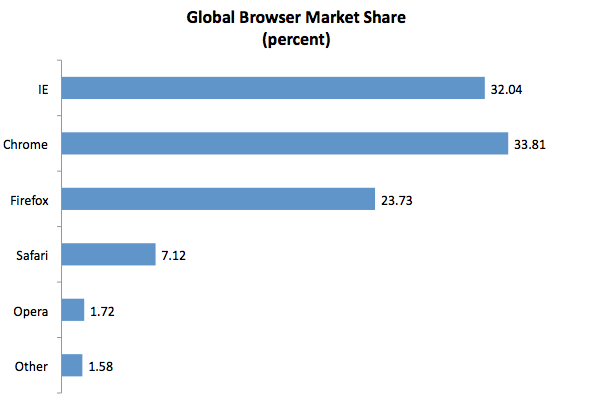
Microsoft’s IE has the largest share of the US PC browser market at either 41 percent or 54 percent, depending on which numbers you believe. However, on a global basis, several sources have recently proclaimed Chrome the browser market leader.

Source: StatCounter (8/12)

search engine marketing strategy search engine marketing tips

Secrets of Content Marketing World: Agent Jason Falls, Social Media Explorer

Jason Falls Content Marketing Secret Agent There’s a lot of power in words and even more in secret words. This week we’ve been leaking content marketing secrets all over the web and hopefully you’ve been paying attention. In particular, you’ll want to tune in to the no-nonsense approach from this special agent of content marketing, Jason Falls, the CEO of Social Media Explorer.
Jason has been a vocal advocate of practical online marketing and PR for years and his experience with blogging and blog consulting may very well be the one thing you need to experience to justify your own secret mission to Columbus next week for Content Marketing World. For a sneak peek at Jason’s business blogging and content marketing secrets, check out the following interview.

BTW, we could tell you how we were able to get these secrets out of Jason, but then we’d have to “kill” you. With content of course.

You’re a busy man! As an author, speaker, blogger and the CEO of Social Media Explorer, how has your work with content as a marketing asset evolved? What do you think about all the recent buzz about “content marketing”? What’s BS and what’s the truth?

If anything, I’d say that my work with content marketing has grown more critical to each client we work with. Without exception, every client Social Media Explorer has worked with in the last three years, and even the clients I worked with in my previous role at Doe-Anderson, had content at the core of what made them successful online. In my mind, the digital and social marketing roles for a business are there to help create a holistic and consistent consumer experience with the brand. Content drives the online touch points. Without it, all you have are ads, which, by the way, also constitues content.

What do you consider to be reasonable goals for a content marketing program that’s focused on showing a business return, whether it’s sales, retention or something else?

It depends on a lot of factors — size of brand, scope of goals, size of audience/customer base, passion brand or more utility/commodity brand — but I think reasonable goals are to establish a connection between online content marketing efforts and either unit sales, revenue or cost savings, then grow that baseline as the effort matures. You’re going to start with very little needle moving at first for many brands, but as you build and attract more relevant audience members to your content, the numbers go up … they always do if your content is outstanding and you are consistent.

Your session “Cut the Bull – Blog with a Purpose and Drive Your Business” is focused on taking a no B.S. approach to blogging for business.  What are 3 of the primary takeaways from your Content Marketing World presentation that you think are most important?

That you shouldn’t blog as a business unless you’re going to blog for business. Is that three? Seriously, we’re going to talk about why blogs are business drivers, how you can make yours one, how you can build an audience for it and how you can track and measure your blog’s effectiveness as a business driver. Wait … that’s more than three. Damn.

What are some ways that successful companies are integrating content marketing with other online marketing channels such as social media, digital PR and SEO? Can you share a few examples?

Content Marketing World has one of the best examples in its speaking roster. Marcus Sheridan has created the penultimate small business marketing case study for River Pools and Spas. He used his company blog to simply write content based on answering key customer questions and solving key customer problems. Because he used SEO techniques to optimize for strategic keywords, the content ranked well. The natural traffic has turned their content marketing into a primary customer acquisition mechanism. It’s just awesome. I also like what Western River Expeditions is doing to combine social media, blogging and email marketing to create a beautiful cycle. But to know more about that, you’ll have to come to my session. Heh.

Content is both art and science with high demands on coordinating necessary planning, time and resources. This seems especially true for large, complex organizations with multiple players and diverse needs. What tools, software or services can recommend for large enterprise companies that want to be more efficient and effective at using content to drive new business and engage their customers?

The good news is that there are dozens of really good social media management systems out there to help organize large social content marketing teams and outposts. The bad news is that there are dozens of really good social media management systems out there to help organize large social content marketing teams and outposts. Unfortunately none of them do everything most companies need a content management system to do. For one, most don’t manage your own content (website, blog, etc.) While tools like Awareness get close, most are focused on social channels only. Some of my favorite picks for enterprise social media management systems — all worth looking at — include Expion, Spredfast, Sprinklr, Vitrue and Awareness.

Goals can vary of course, but what are some of the essential “must have” measurements for content marketing success?

Nichole Kelly (my partner in SME Digital) and I almost always insist that your content marketing needs to point customer to a path to conversion. Whether you’re primary measures are online sales or leads for offline sales, we want to formulate strategies that help you drive unit sales, revenues or save costs. Bottom line metrics are the ones that make boards and CEOs happy and get you budget, etc. So we focus much of our efforts there. While you certainly can have awareness, customer service, research and development and more as goals for your efforts, those in your organization who are skeptical of social will always be until you can show them how online content moves financial needles.

What are “secret” 3 predictions that you have for the future and importance of brands and content marketing?

A bank will actually “get it” soon. The entertainment industry will figure it out and lead the way for brands to “get it.” Journalists will soon aspire to be brand reporters.

All of that is made up bullshit, but I might get lucky.

We detect a complete absence of bovine fecal matter in your responses Agent Falls. Congratulations. 

For more no B.S. content marketing secrets, check out Jason’s presentation at Content Marketing World next week: Sept 5th at 10:30am “Cut the Bull – Blog with a Purpose and Drive Your Business”.

Also be sure to check out the TopRank session on the future of optimization: “Optimize and Socialize for Better Content Marketing” – Sept 6 – 3:05-3:50pm (Content Creation & Optimization Track).

What’s your best content marketing secret?
Share your best content marketing secret in the comments below and we’ll pick 3 winners this week to receive a free copy of “Optimize: How to Attract and Engage More Customers by Integrating SEO, Social Media and Content Marketing”.

Who’s next in our series of Content Marketing Secrets?  It looks like Julie Fleischer, Director of CRM Content Strategy & Integration at Kraft Foods.


ppc search engine promotion professional search engine marketing

CNN and Facebook Launch New Election Insights Website

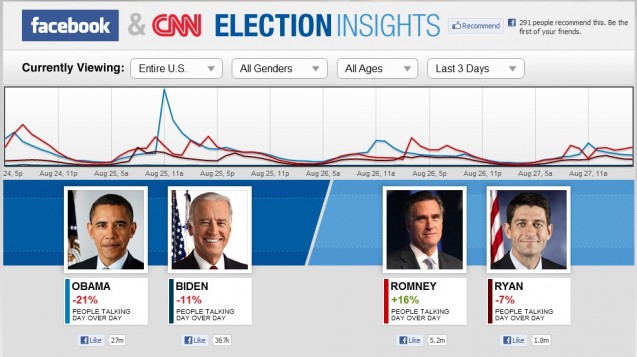
cnn election insightsIn early July, CNN and Facebook announced a new election year partnership that would provide voters and political junkies with metrics based on real-time conversations about the presidential candidates. Yesterday morning, the Election Insights webpage was launched and began displaying real-time data. The political social-monitoring tool, which competes directly with Twitter’s Political Index and Amazon’s Election Heat Map, uses the social platform Mass Relevance to process and aggregate politically based content from Facebook.

The new interactive chart, which displays a wealth of information in an easily digestible format, makes it simple for users to:

  • View the trends and aggregated data from Facebook to better understand the quantity of people talking about the candidates
  • Access specific data by using state, gender, age, and time decay filters to better understand various voting demographics
  • “Like” the Obama, Romney, Biden, and Ryan Facebook Pages
  • “Like” the Election Insights or CNN Politics Page
  • Use the Facebook Comments plug-in to join the CNN Insights discussion

KC Estenson, the senior vice president for CNN Digital, indicated CNN was happy to partner with Facebook on this election-year project:

“We are excited to build on our long relationship with Facebook to transform social media conversation into real-time data. By teaming up with Facebook and Mass Relevance, we can effectively gauge the buzz surrounding this election and deliver it to CNN Digital users, literally as it’s happening.”

Elliot Schrage, the VP of Corporate Communications at Facebook, said the following:

“Facebook is naturally a place where friends engage in political discourse, and we’re pleased to announce that the Facebook-CNN Election Insights tool will offer an interactive, real-time glimpse into how and where this conversation is taking place across the country.”

In addition to the providing voters online access to the webpage, CNN will be using the data for on-air broadcasts.

Sources Include: CNN Insights, CNN Pressroom, and Mass Relevance

David Angotti

David Angotti

During my time as a managing member of an educational startup I gained direct experience related to business development, search engine marketing (SEM), search engine optimization (SEO), conversion rate optimization (CRO), online marketing, mergers and acquisition, product development, and branding. I successfully exited the startup in late 2009 and I am now a freelance internet marketing and brand development consultant.
David Angotti

@DavidAngotti

Follow @DavidAngotti
David Angotti
David Angotti

+David Angotti

David Angotti

Latest posts by David Angotti (see all)

  • CNN and Facebook Launch New Election Insights Website - August 28, 2012
  • Jury Finds Samsung Guilty of Patent Infringement - August 27, 2012
  • Google Job Listing Reveals Plan to Protect Users’ Privacy - August 24, 2012

Tuesday, 28 August 2012

The Difference In Keyword Research For SEO vs. PPC

search engine marketing professionals search engine marketing reporting

A Minimalist Approach To Global Keyword Expansion & Monitoring

guaranteed top search engine ranking high search engine placement

Why We Had a Company-wide Meetup (and How to Execute One Yourself)

A successful start-up depends fully on a foundation of employees who can effectively communicate, hustle, and essentially get sh*t done.

Today, you can find these traits in every Distilled team member—communication is the underlining glue that holds us together. Whether it’s talking to another office member or pitching a sensational idea to an eager client, it all boils down to how efficient we are at getting our message across.

However, our communication wasn’t always so good.

Rather, we had to be forced to involve other teammates across offices. We’d discuss ideas awkwardly, not really appreciating what others could bring to the table. It took a while to realize communication was the issue. It’s simple in theory, but in reality, it involves so much more than sending an email or picking up the phone. True communication comes from actually forming a bond with the person on the other side of the conversation, and these relationships are best developed when face to face.

So our execs decided, “Well, let’s get everyone meeting face to face.” And so we did.

The Details

When Distilled first started, it was easy to keep the building blocks together. A few team members huddled in a small, open office space and not only facilitated communication, but required it. As the business started to expand, first by a few employees and eventually by a few thousand miles, it became clear that as Distilled grew, it would be difficult to work together as seamlessly as before.

So in January 2012, Distilled flew all 50 employees to the U.K. headquarters for the first annual “Distilled-a-thon,” a week-long event catered to building relationships and boosting moral between all three Distilled offices (located in London, Seattle, and NYC).

The PC version of went down is this: Through a series of team building exercises, presentations, and meetups, employees were not only able to finally put faces to names, but also develop the level of rapport and trust that is necessary for true, authentic communication.

The real version is this: We got hardly any client work done. We got no sleep. We went on (classy) drinking binges and got to really know each other. So while the team building exercises helped us learn what each person could bring to the table professionally, it was this collective lack of sleep and bonding that helped us learn who each of us was.

The Benefits

  • Face-to-face relationship building
  • Boost in office moral
  • Improved communication
  • Communicating a plan for the future

While Google Chat and Skype can be great alternatives for everyday communication upkeep, there is absolutely no substitute for an actual, in-person conversation. Email is convenient for quick messages, but lacks the emotional depth necessary to really get to know someone. Everyone responds to conversation differently, and body language is typically the cue we use for determining how to best interact with each other.

By allowing employees to meet and foster those relationships, we were able to understand how to communicate more efficiently on an individual basis, thanks to the cues we gave and received while interacting in person. For example, I learned Mark likes things directly to the point and that Dave can put his head down and get sh*t done like no other. Oh, and you may think Pete is quiet but he’s got damn opinions (and a penchant for whiskey).

It also served as a perfect opportunity for management to share their ideas and visions for the future of the company, boosting moral and providing an opportunity to see exactly what we, as a start-up, have the potential of becoming. Being able to see and interact with people that share the same commitment and drive is inspiring and serves as a good reminder of why we work so hard, so we can all succeed, both as individuals and as a work community.

How to Plan Your Own Meetup

  • Get past the excuses. There are all sorts of excuses for putting off an office-wide meet up. Objections could be the extreme amount of coordination necessary to put day-to-day operations on hold. Another could be the financial aspect involved with getting so many people to one location. While these could be off-putting (especially for a small business or start-up with limited funds) it must be remembered that the foundation of any successful business will always be the team, and it should be considered a serious investment.
  • Make a plan. If the cost factor is scary, research travel sites that offer discounted rates for booking group accommodations. If the coordination of 10+ people sounds like an office nightmare, try an app that will help take the agony out of planning. If putting work on hold for a week is an issue, set aside certain hours each day for client work (but be sure to work on it as a team to continue the “getting-to-know-you” process).
  • Just do it. There will never be a “perfect” time to plan an office-wide meetup; especially in a start-up, there is always work that simply has to be done. But the key to it all is this: By investing time in your team now, you are creating a more engaged and productive team for the future.

To this day, our company-wide meetup proved to be the smartest decision Distilled made on the path to forging a strong foundation and community work environment, and it is hopefully just one of many events we will have in the future. I highly recommend giving it a shot, and hopefully you, too, will see just how much it can change your business and strengthen the foundation on which you will continue to grow.

Image Credit: Shutterstock / Dmitriy Shironosov

Adria Saracino

Adria Saracino

Adria Saracino is the Head of Outreach at Distilled. When not connecting with interesting people on the web, you can find her writing about style on her personal fashion blog, The Emerald Closet.
Adria Saracino

+Adria Saracino

Adria Saracino

Latest posts by Adria Saracino (see all)

  • Why We Had a Company-wide Meetup (and How to Execute One Yourself) - August 28, 2012
  • Your Step-by-Step Guide to AdWords - June 22, 2012
  • SEO for Facebook – New Video Revealed - June 15, 2012

Evaluate & Energize Your Social Content Marketing Strategy #SMBMSP48

#SMPMSP48 Crowd

Note from Ashley: Please welcome this guest post from Shawna Kenyon, an Associate Account Manager with TopRank Online Marketing.

As I settle in for my first Social Media Breakfast #SMBMSP48 at 514 Studios, I survey the area and see some familiar faces and others less familiar. As the caffeine starts to kick in, the stage is set and the crowd welcomes presenter Lee Odden. As an Associate Account Manager at TopRank Online Marketing, this isn’t the first time I have heard Lee speak about social media as it relates to content strategy, but I always learn something new each time.

Lee sets the stage by posing a question to the crowd; ‘What are your primary goals when it comes to social media?’ Awareness, engagement, customer service, direct sales or is it something else altogether? Most of the crowd is split between awareness and engagement, but very few identified direct sales or customer service as a primary goal. While there isn’t really a right or wrong answer to this question, it’s always interesting to see how fellow marketers measure success.

Although the audience members at today’s event may have different goals, we all have one target in mind for our social efforts: the customer. As marketers, social strategist and business owners we have the ability to create, consume, publish, interact and transact online. With 88% of brand and agency marketers using social media for social content distribution, how can social be leveraged in a way that’s meaningful enough to attract and engage customers? Below are five questions that can help evaluate and energize your current social content marketing strategy.

1) Why Invest in Social?

It’s important to first define the correlation between what you want to achieve as an organization, and how you want your audience to feel about you. Is what you’re putting out into the social sphere optimized for the best possible performance? Do you know what your customer’s goals are and how they align with the business goals your company is trying to achieve? This dialogue has to go beyond features and benefits, tell a story and make that a part of your content strategy. If from there it can be determined how best to integrate through social, that’s the win.

2) Who is Your Audience?

Do you understand the consumer? Who is your target audience? Are they new or existing customers, and are you optimized for those audiences? If we understand our audience we have an opportunity to appeal to them based on what they want and what’s important to them, and in turn create content that speaks to them throughout the sales process. By empathizing with customer’s wants and needs and knowing why they care about you as a company, you can leverage that through content marketing and deliver it to those customers in a way that speaks to them.

If we examine a hub and spoke model, assuming we know our primary goal or objective, we can do more than just release a piece of content on Facebook or YouTube. We can utilize our existing networks to exponentially increase the reach of that content. It’s not about just putting something up on Slideshare, its segmenting that content and posting it to Facebook and Twitter, publishing a blog or a white paper and truly leveraging what audience you have and motivating them to take action. If you’re going to take advantage of a model like this it’s imperative you continually grow those networks.

3) Are You Optimized for Consumption?

The notion of content optimization isn’t just about SEO; optimization is a continuous effort to make something better over time. SEO itself can be very limited to just search engines; optimization is relevant to all content and objectives. If we understand who we are trying to do business with we need to understand three things:

  • How do they discover information?
  • What are their preferences when it comes to topics and in what format do they prefer? What does your target audience appreciate that would motivate them to take action?
  • How do we retain and evolve that customer?

Creating a better user experience requires that you know what your customers are talking about, and then blend that information into a social plan. Be focused and you will stand out.

4) What’s The Customer Journey?

Traditional sales funnel would suggest we bring most consumers to the top of the funnel. But if we look at what might be more relevant to customers throughout the entire buying cycle we can create awareness. From a 360 degree perspective we look at the lifecycle as Awareness, Interest, Consideration, Purchase, Retention and finally Advocacy. It’s important to be optimized in every phase of that customer journey and map content to throughout each phase.
People tend to make decisions based on emotions, so think about how you want people to feel when they consume your content. Instead of publishing an infographic, determine where that infographic fits within the customer journey. Remember it’s not the media format that’s most important it’s the information. Don’t fall into the trap of creating content for SEO, content should be created for people and THEN you bring in SEO.

5) How Do You Measure Value? 

If the key performance indicators or KPI’s have been defined, the next step is measuring the progress being made to achieve those goals. What’s our share of voice how many times are people talking about us vs. our competition? Are we improving the customer experience? Are we increasing orders?
Social media is about meaningful relationships with people who will take action when asked. It makes more sense to produce a smaller quantity of content that has a higher level of engagement than it does to produce a large quantity of content that elicits little to no engagement. Knowing the level of engagement customers expect can determine what they are going to deem quality. Once you know that you can then optimize for it.

Optimization whether it be search or social is an approach, so set goals, test, revise, scale and repeat. There are the talking heads out there that might provide insight from time to time, but those who have experienced high levels of success have done so because they have learned to test and adapt based on their experiences. For more information on how to optimize your content strategy check out this blog on Content Marketing 101.

Speaking of your own experiences, what questions have you posed or tested to inform your social strategy? Demonstrate your social genius with a comment below.


local search engine optimization local search marketing services

Daily Search Forum Recap: August 27, 2012

Here is a recap of what happened in the search forums today, through the eyes of the Search Engine Roundtable and other search forums on the web.

Search Engine Roundtable Stories:

  • Are DMCA Requests Up After Google's Algorithm Announcement?
    On August 10th, Google announced that valid DMCA requests are part of their algorithms for search quality. We expected a bunch of new SEO services to come up where you would pay a monthly fee to submit your competitors sites to Google's DMCA forms. We expected that DMCA takedown requests would surge.
  • Google: Subdomains & Subdirectories Equal For Geo SEO Purposes
    If I had my way for serving up localized and geographic specific international content, I'd go with a gTLD (country specific top level domain). But it isn't always possible or practical. When you can't, you should probably go the subdirectory or subdomain approach...
  • Google's Cutts: We Don't Use Chrome Data For Search Quality
    Bill Hartzer said he spoke to Google's Matt Cutts at SES San Francisco a couple weeks ago, where he asked Matt if Google used Chrome browser data for search ranking or quality purposes. Matt told Bill that Google does not use Chrome data for search ranking or quality purposes.
  • Apple Wins: Samsung Infringes: Is Mobile Search Affected?
    Late Friday, the court ruled in the patent case of Apple versus Samsung. In short, Apple destroyed Samsung and most of the claims of patent infringement against Samsung were found legit. Apple was awarded about $1...
  • IAC Buys About.com For $300 Million
    New York Time's About.com sold for $300 million but not to Answers.com as we expected, instead it was sold to Barry Diller's IAC. The news is out and despite IAC coming late to the game on the offer to buy About.com...
  • Belly Dancer At Google
    Chris Schrier posted a picture on Google+ of a TGIAF event at Google New York's office of a belly dancer entertaining Googlers during live music. It appears this is being done at one of Google's balc

Other Great Search Forum Threads:

basic search engine optimisation best search engine optimisation

Jury Finds Samsung Guilty of Patent Infringement

apple samsung patent trial overOn late Friday afternoon, a juryin a San Jose federal courtroom handed Apple a major legal victory in a landmark patent trial. The jurors, who according to the foreman believed Apple’s demand of $2.75 billion in damages was “extraordinarily high,” ultimately decided that Samsung should be required to pay Apple $1.05 billion in damages.

The case, which was extremely complex, examined the use of multiple technologies on over 30 mobile devices. One of the patents that the jury upheld was Apple’s Pinch-to-Zoom technology. As a result of upholding this single patent, other mobile phone manufacturers will be prohibited from including this popular option on all future devices.

John Quinn, the lead attorney for Samsung, said, “This decision should not be allowed to stand because it would discourage innovation and limit the rights of consumers to make choices for themselves.” In addition, he indicated the legal team would request the jury’s verdict be tossed out and promised to fight on.

Katie Cotton, the head of public relations for Apple, indicated that Apple was pleased with the verdict:

“We make these products to delight our customers, not for our competitors to flagrantly copy. We applaud the court for finding Samsung’s behavior willful and for sending a loud and clear message that stealing isn’t right.”

A spokesperson for Samsung said the following:

“Today’s verdict should not be viewed as a win for Apple, but as a loss for the American consumer. It will lead to fewer choices, less innovation, and potentially higher prices. It is unfortunate that patent law can be manipulated to give one company a monopoly over rectangles with rounded corners, or technology that is being improved every day by Samsung and other companies.”

Will this verdict stifle future innovation or was it an appropriate penalty for patent infringement? What do you think?

Sources Include: USA Today & TechCrunch
Image Credit: Shutterstock

David Angotti

David Angotti

During my time as a managing member of an educational startup I gained direct experience related to business development, search engine marketing (SEM), search engine optimization (SEO), conversion rate optimization (CRO), online marketing, mergers and acquisition, product development, and branding. I successfully exited the startup in late 2009 and I am now a freelance internet marketing and brand development consultant.
David Angotti

@DavidAngotti

Follow @DavidAngotti
David Angotti
David Angotti

+David Angotti

David Angotti

Latest posts by David Angotti (see all)

  • Jury Finds Samsung Guilty of Patent Infringement - August 27, 2012
  • Google Job Listing Reveals Plan to Protect Users’ Privacy - August 24, 2012
  • Facebook Messages Testing Recent Design Overhaul - August 23, 2012