SPONSORS

Sunday, 30 September 2012

Google Issues “Weather Report” Of Crack Down On Low Quality Exact Match Domains

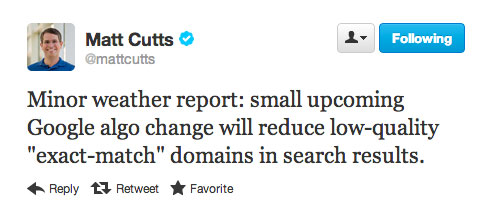
The head of Google web spam fighting team Matt Cutts announced on Twitter that Google will be rolling out a “small” algorithm change that will “reduce low-quality ‘exact-match’ domains” from showing up so highly in the search results.

Cutts said this will impact 0.6% of English-US queries to a noticeable degree. He added it is “unrelated to Panda/Penguin. Panda is a Google algorithm filter aimed at fighting low quality content; Penguin is one aimed at fighting web spam.

This should come as no surprise, as Cutts said a couple years ago that Google will be looking at why exact domain matches rank well when they shouldn’t, in some cases.

Likely over the coming days, you will see shifts in the search results where many sites that may rank well based on being an exact match domain may no longer rank as high in Google’s search results.

Exact match domains mean domains that match exactly for the search query. For example, if I sold blue widgets and owned the domain name www.bluewidgets.com, that would be an exact match domain.

Keep in mind that this doesn’t mean sites with keywords they hope to rank for in their domain names are now doomed. Rather, the change aims to target low quality sites that might be riding on on the basis of exact matching.

For a broader perspective on Google algorithm updates, see The Return of the Google Dance on our sister site, Marketing Land. As for ranking factors overall, be sure to see our Periodic Table Of SEO Ranking Factors.

search engine marketing sem search engine marketing service

B2B Marketing Innovation eBook – Break Free of Boring B2B With These 33 Tips

b2b marketing innovation

Is your B2B marketing feeling “old fashioned” and out of date? Have your white papers, direct mail and webinars been called out as “boring”? Maybe you’re losing interest with prospects because corporate chest beating about products and services just isn’t enough anymore?

There’s a growing movement amongst progressive business to business marketers to break free of stale and antiquated digital marketing tactics. While consumer product marketing has long been associated with more interesting and compelling marketing efforts, modern B2B marketers include numerous companies that are creating amazing programs to attract, engage and convert business buyers with infotaining content, compelling social engagement and memorable calls to action.

As a build up to the MarketingProfs B2B Forum conference in Boston, over the past week we’ve been working on an eBook and publishing a series of interviews covering the topic of B2B Marketing Innovation with advice from speakers at the #mpb2b event. These smarties represent some of the top B2B brands in the world, including: Cisco, IBM, SAP, Salesforce, Silverpop and Monetate. We’ve also tapped many of the web’s most prominent B2B, social media and content marketing thought leaders including Joe Pulizzi, Ann Handley, Amber Naslund, Paul Gillin, CC Chapman, Amanda Maksymiw, Michael Brenner, Adele Revella and many more.

We added a twist to the B2B Marketing Innovation interview series by encouraging our readers to suggest their own hard won tips. With the incentive of winning a copy of Content Rules AND a copy of Optimize, we attracted some pretty good insight.

The best 3 B2B tip givers really hit the jackpot though (Lynn O’Connell, Scott Williamson, Joe Yaeger) and were included in an eBook that Ashley Zeckman and I put together which will be shared with the MarketingProfs community of over 400,000, our network of over 150,000 plus the thousands that read our blog every day.

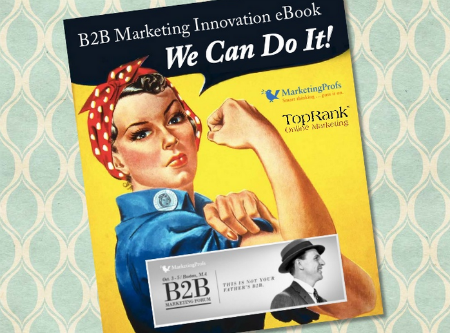
But you don’t have to wait for those eBook promotions, because you can download the eBook in PDF format, by clicking on the cover image below:

b2b marketing innovation eBook

Click image to download eBook

We took a bit of a “retro” angle to the theme of the eBook to work in tandem with MarketingProfs branding of the event: “This Is Not Your Father’s B2B”.  From the importance to data to use of visual content and humor, this eBook is chock full of practical advice for B2B marketers to be more innovative with their marketing. There are tips, examples and plenty of hard won insights from practitioners and thought leaders alike.

33 B2B Marketing Innovators and Their Topics:

1. Customer = Hero – Ann Handley
2. Engaging Content – Michael Brenner
3. Stop Talking & Listen – Joe Pulizzi
4. Study Deeply – Christopher Penn
5. Be First & Fail – Rob Yoegel
6. Actively Adapt – Amber Naslund
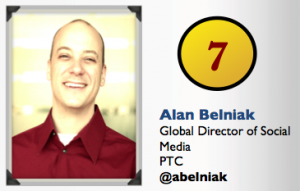
7. Remarkability – Alan Belniak
8. Do the Unexpected – C.C. Chapman
9. Borrow Freely – Roberta Rosenberg
10. Automation Tools – Kathleen Christoph
11. Have Understanding – Mack Collier
12. Buyers Are People Too – Amanda Maksymiw
13. Steal Shamelessly – Ellen Valentine
14. Create A Theme – Paul Gillin
15. Honest & Factual – Jeane Hopkins
16. Uncover the Truth – Adele Revella
17. I’m Eric Granof – Eric Granof
18. Use Web Data – Chad Horenfeldt
19. Customer Needs – Susan Emerick
20. Talk To Customers – Matt T. Grant
21. Stick To Basics – Lou Imbriano
22. Serve Up Information – Shelly Kramer
23. Innovation Day – Mark Rice
24. White Paper Rut – Corey O’Loughlin
25. Awesome Audiences – Tom Fishburne
26. Tell Stories – Tim Washer
27. B’s & C’s Are People – Dave Thomas
28. Be Creative – Kami Huyse
29. Flexible Content Plan – Marti Konstant
30. Listen for Gold – Lee Odden
31. Appeal to People – Lynn O’Connell
32. Proof of Quality – Scott Williamson
33. Likes VS. Shares – Joe Yeager

Here’s a link to directly download the PDF of the B2B Marketing Innovations eBook. Feel free to post it and share. Below you can view the eBook embedded from Slideshare and get the embed code to easily add it to your own site.

Thank you again to the speakers from the MarketingProfs B2B Forum who were able to participate in this project and to our readers who contributed their B2B smarts as well.

If you’re attending the B2B Forum in Boston next week (if you’re in the area it’s a MUST) then I hope to see you there. I’ll be giving a track keynote Friday, October 5th at 8:15am on Optimizing Search, Social and Content across the Buying Cycle.


organic search engine optimization services organic search engine placement

Google EMD Update: Exact Match Domains No Longer Rank As Well

Google EMDLate Friday afternoon, Google's head of search spam, Matt Cutts, dropped a bomb on some webmasters and SEOs.

He announced on Twitter that Google is going after "low quality" exact match domains (EMD) to ensure they do not rank well in the Google search results. Matt said this algorithm update only impacts 0.6% of English-US queries.

He has two tweets on this, here they are:

Honestly, I am a bit surprised it took Google so long to do this. I mean, Matt said publicly that Google will look into exact match domains almost two years ago. I would have thought Google would have done something shortly after. Maybe they have and maybe this is just an update to that? I am not sure. But this shouldn't come as a surprise to anyone going after the exact match domains.

I believe Google was slowing pushing this out a few days ago, on Thursday night. I saw an uptick in SEO chatter in the WebmasterWorld thread but I really didn't think it was Panda or Penguin related, which it wasn't, so I decided to wait it out and see what I could find out over the weekend. It was this, an exact match domain algorithm change.

It seems like many sites were hit, as many webmasters have reported being hurt by this update. A WebmasterWorld thread has several webmasters claiming to be victims. I will do a poll on this in about a week, I don't want to poll our readers until they have time to investigate if they were impacted by this. But it seems pretty significant, especially for SEOs and domainers.

SEOmoz has some early data on who was hit and how many sites were impacted. They say it seems like a pretty big update and shared this chart via mozcast:

Google EMD mozcast report

Anyway, this is a special weekend report - I rarely do this but hey, I am offline Monday and Tuesday.

Forum discussion at WebmasterWorld, Google Webmaster Help and DigitalPoint Forums.

london search engine optimization london search optimisation company

StumbleUpon: Why Your Business Needs It

Source: StumbleUpon Pages | Official Sign Up and Homepage

With too many social media sites now available on the Internet, it can be overwhelming for you to pick which to use for your business. This could cause frustration and may even confuse you in knowing which social network can help with your online marketing campaign. Well, the key here is to weed out the website that won’t be able to help you in building an online presence.

What is StumbleUpon?

StumbleUpon is a social media and voting site rolled into one. This allows you to share content within your community based on your interests. Meanwhile, it also lets you vote other content by liking or up-voting it.

This is just the basic. You can delve deeper and discover ways on how you can promote your business further. However, you need to be active on this social media site by clicking the “Stumble!” button and up-voting and down-voting content. And the more you become active, the more you’ll learn ways on how StumbleUpon can help your business.

Exposes Content to the Right Audience

There are various ways on how StumbleUpon can help you with your business. First, adding and sharing your content using the proper keyword and right category that suits it can expose your message to your ideal audience. The more users discover it, the easier for you to establish your brand on the network with the people who share the same interests as yours.

By exposing your content to the proper audience, it has a higher chance of receiving an up-vote. As a result, it will bring higher page views to your website. This could also help you earn from your content, especially if it is associated with your business and you’re using the power of content to promote it.

Allows Content to Reach Wider Audience

As mentioned earlier, StumbleUpon allows you to expose your content to the right audience. From there, users can up-vote it and share it with their connection. As a result, your content is being promoted to another group of users, who can be your potential followers and eventually your market. In one way or another, StumbleUpon serves as a “digital word of mouth” for your content.

Before You Begin

Although StumbleUpon is a great way to expose your content, that doesn’t mean that you can flood your account, as well as your followers’ page, with your content. You should also share content from other relevant resources. The network was initially designed to build a community and not as a marketing tool, so you have to respect every member of it. After all, users will know whether you’re using the network for your personal gain.

Aki Libo-on

Aki Libo-on

Aki is a twenty-something year old Manila girl who works as a Web Content Writer for About Social Media. She loves to eat, read books of various genres, and write more than anything because those are the things that keeps her sanity intact.
Aki Libo-on

+Aki Libo-on

Aki Libo-on

Latest posts by Aki Libo-on (see all)

  • Using Pinterest to Boost Your Website’s Traffic - September 28, 2012
  • Understanding Facebook Insights - September 27, 2012
  • The Truth About Social Media Marketing - September 27, 2012

search engine marketing consultant search engine marketing consultants

StumbleUpon: Why Your Business Needs It

Source: StumbleUpon Pages | Official Sign Up and Homepage

With too many social media sites now available on the Internet, it can be overwhelming for you to pick which to use for your business. This could cause frustration and may even confuse you in knowing which social network can help with your online marketing campaign. Well, the key here is to weed out the website that won’t be able to help you in building an online presence.

What is StumbleUpon?

StumbleUpon is a social media and voting site rolled into one. This allows you to share content within your community based on your interests. Meanwhile, it also lets you vote other content by liking or up-voting it.

This is just the basic. You can delve deeper and discover ways on how you can promote your business further. However, you need to be active on this social media site by clicking the “Stumble!” button and up-voting and down-voting content. And the more you become active, the more you’ll learn ways on how StumbleUpon can help your business.

Exposes Content to the Right Audience

There are various ways on how StumbleUpon can help you with your business. First, adding and sharing your content using the proper keyword and right category that suits it can expose your message to your ideal audience. The more users discover it, the easier for you to establish your brand on the network with the people who share the same interests as yours.

By exposing your content to the proper audience, it has a higher chance of receiving an up-vote. As a result, it will bring higher page views to your website. This could also help you earn from your content, especially if it is associated with your business and you’re using the power of content to promote it.

Allows Content to Reach Wider Audience

As mentioned earlier, StumbleUpon allows you to expose your content to the right audience. From there, users can up-vote it and share it with their connection. As a result, your content is being promoted to another group of users, who can be your potential followers and eventually your market. In one way or another, StumbleUpon serves as a “digital word of mouth” for your content.

Before You Begin

Although StumbleUpon is a great way to expose your content, that doesn’t mean that you can flood your account, as well as your followers’ page, with your content. You should also share content from other relevant resources. The network was initially designed to build a community and not as a marketing tool, so you have to respect every member of it. After all, users will know whether you’re using the network for your personal gain.

Aki Libo-on

Aki Libo-on

Aki is a twenty-something year old Manila girl who works as a Web Content Writer for About Social Media. She loves to eat, read books of various genres, and write more than anything because those are the things that keeps her sanity intact.
Aki Libo-on

+Aki Libo-on

Aki Libo-on

Latest posts by Aki Libo-on (see all)

  • Using Pinterest to Boost Your Website’s Traffic - September 28, 2012
  • Understanding Facebook Insights - September 27, 2012
  • The Truth About Social Media Marketing - September 27, 2012

orange county search engine optimization organic search engine marketing

B2B Marketing Innovation: Why Before What in Social Media Strategy – B2B Insights from Mack Collier

Determining why your company should engage in a social media plan is one of the first and most important steps.  Working towards the “what” without the “why” can result in wasted time, money and set a B2B marketing program off track.

Next up in our B2B marketing innovation interview series is Mack Collier, a well known and respected social media strategist and trainer specializing in helping companies better connect with their customers via social media. Mack is also the force behind #BlogChat, the largest organized chat on Twitter.

In this interview, Mack dives into four things brands can do to cultivate and connect with fans, as well as well as three basic questions every marketer should ask themselves before embarking on a social media marketing program. He also offers sage advice on B2B marketing innovation and tools.

Please tell us about you and the kind of B2B marketing work you’re most excited about.  Solve any tough ones lately?

The thing that really excites me about blogging, social media, content marketing, etc. is that I think we are getting back to the idea of creating marketing communications that can also create value for our customers.  I think we are getting away from the days when you ‘win’ the sale by simply banging customers over the head with your commercial 15 times, to creating content that also creates value, which helps build connections as well as your expertise.

What are the essential starting points small businesses should consider when employing social media marketing and blogging in the B2B space?

I think the most important starting point for a small business or ANY business using social media or starting a blog is to answer this question: “We are using social media because we want to ________.”

Too many businesses start using social media without asking themselves WHY they want to start using social media.  (Hint: ‘Cause everyone else is’ is NOT an acceptable answer)  Once your business can fill in that blank, then you can craft a social media strategy that actually helps you reach that goal.

There’s a common association that it’s tough to come up with new B2B marketing ideas, but as you know, innovation exists within B2B as much or more as it does with consumer marketing – just in different ways.  What’s your process for coming up with new and innovative ideas for your B2B marketing efforts?

It’s tough for most businesses to come up with ANY new marketing ideas.  But I think that’s often the case because businesses view their new marketing effort as ‘How is this going to help us stand out?’ vs ‘How is this going to help us create value for our customers?’  I think the growing trend of embracing content marketing is really helping businesses to review the idea of creating value via marketing, which I think is awesome.

An essential part of building a business online is to attract and engage a community.  What are your most practical tips that companies and brands should consider for connecting with and cultivating fans?

There are four things that brands can do to cultivate and connect with their fans:

  1. Be a part of the audience they want to connect with.  Look at the world through the eyes of your customers.  How does Harley Davidson do market research?  By jumping on their Harleys and going for a ride on the weekend with their customers.  The brands that do the best job of connecting with their fans look at their world the eyes of their most passionate customers.
  2. Embrace your fans.  The biggest mistake most brands make when it comes to their fans is that they leave them alone.  Your fans are special people that WANT a deeper connection with your brand.  Reward that desire and look for ways to build a deeper connection with them.
  3. Focus on the ‘Bigger Idea’ behind your brand.  Don’t focus on your product or service, focus on what your customers do with your product.  For example, in its content Patagonia focuses on issues that are relevant to its customers, such as sustainability, protecting the environment, and being active outdoors.  This approach makes its products more relevant to its customers.
  4. Look for ways to shift control to your fans.  If you want to make your marketing more relevant to your customers, make sure it is spoken in a voice that they can understand and relate to; Their own.  I’m not talking about simply crowdsourcing your marketing, but understanding your customers, and giving them input into the direction of your brand.  Remember that your fans WANT to be heard by your brand.  They want to know you are listening, and if you show them you are, that only validates their love of your brand.

Developing a solid B2B marketing plan takes research, and understanding of the customer goals, pain points and journey.  What are some of the most common myths or mistakes you’ve seen with B2B marketing planning?  Any tips on how to be more successful? 

One of the great things about the rise of social media and digital communications tools is that it makes it far easier for engaged businesses to better learn about and understand its customers.  There’s an exponential increase in content being created by…well everyone, and that content can be distilled down into valuable customer insights for the businesses that are willing to put in the legwork.

I think one of the biggest mistakes B2B companies can make is to form a picture of who their customers are based on outdated or incomplete information.  Leverage these new social tools as a way to better understand and segment your customers to improve your marketing efforts and make them more effective and efficient.

With all the hype in the business marketing media, it’s tempting for companies to chase trending B2B marketing tactics like visual marketing or social networking.  How do you decide what the right B2B marketing tactical mix is for companies that you work with?

I think all companies really need to focus on their available resources and do NOT fall for the ‘shiny object syndrome’ and start using whatever the ‘hot’ social media tool or site of the month is.  I think it goes back to asking and answering three basic questions:

  1. Who are we trying to reach?
  2. What are we trying to accomplish?
  3. What are our resources?

Let your goals define the tools you will use, not the other way around.

Companies that are in search of business growth with limited resources can often close part of the gap with tools.  What tools do you recommend for B2B marketers (or marketers in general) to get more out of their online content and social media investments?

Well I hate to give advice on which tool is best because I think that your goals/resources/audience defines the tools for you.  But, when it comes to social media, I think right now there are two main tools to look at for B2Bs:

  1. Blogs.  I will always love blogs because with a blog you control the content platform.  That’s huge, and it allows you to create content that search engines love.
  2. LinkedIn.  It’s simply more business-oriented, and there’s a higher probability that you can find key decision-makers and cultivate a relationship with them.

Now in general, it’s impossible to ignore Facebook simply because it’s userbase is so massive.  If you are a business operating in the tech sector, it might be worthwhile to investigate Google Plus as well.

Please share your advice for other B2B marketers out there on how they can be more innovative.

In general, I think we all tend to overthink marketing.  I think it all goes back to understanding who we are trying to connect with and how we can create communications that are valuable for them.  For B2C brands, that might be less about the product and more about how customers will use the product and what they will do with it.  For B2Bs, the idea is the same, its more about how another business will use your product or service to more effectively and efficiently run its business.  I think a good starting point is to ask yourself ‘What business problem does our product or service help solve?’  Create marketing that focuses on the direct benefit for businesses.

Thank you for your insights Mack!

If you’re looking for even more insight on making your business more innovative, be sure to attend a recap of the first day of the conference on #BlogChat on October 4th.  Mack will also be participating in the One-on-One (Marketing) Therapy on the topic of blogging for attendees looking for a little more input from an industry expert.

Also be sure to check out the TopRank session on 360 degrees of optimization with search and social media marketing: “Integrating Content, Search & Social to Optimize the Funnel” – Friday, October 5th at 8:15am.

We’ll be releasing an eBook soon that’s chock full of B2B Marketing Innovation tips from B2B marketing champions like IBM, SAP and Silverpop, so be sure to check back!

What’s your best B2B Marketing Innovation tip?
We would love to hear from you.  Share your best B2B marketing innovation tip by Wed 9/27 and you will have a chance to win two of the best books on content marketing: Content Rules by Ann Handley and C.C. Chapman and Optimize by Lee Odden (hey, that’s me!).


internet marketing search engine specialist internet search engine marketing

Saturday, 29 September 2012

Media.net Partners with Yahoo! Bing to Provide Context Ads

The doors are now open to a fresh supply of targeted contextual ads for Web publishers from the Yahoo! Bing Network. Thanks to a partnership with Media.net, Web publishers can now create and customize highly relevant, targeted contextual advertising units for their websites from among the ads running on the Yahoo! Bing Network.

Here are the key features of the program for publishers as outlined by the press release:

  • Easy-to-use: Ads can be added to a publisher’s website in minutes using the Media.net powered self-serve platform. Publishers can select an ad size and copy-paste the HTML provided on their webpages to start displaying targeted sponsored links and ad topics.
  • Premium advertiser pool: Access to the Yahoo! Bing Network consisting of millions of ads and ad topics.
  • Robust targeting: Proprietary Media.net technology scans all the content on webpages and delivers highly relevant ads.
  • Customization: Publishers can use the Media.net platform to pick from multiple ad sizes, skin the ads to match their look-and-feel requirements and even request highly customized ad units.
  • Control: Publishers can influence the ad targeting on a webpage by providing hints (keywords). Also, unwanted advertisers and ad topics can be easily blocked.
  • Dynamic optimization: Ad units consist of sponsored links, ad topics, or a combination of both, as determined on an impression-by-impression basis to maximize ad yield.
  • Placement flexibility: Publishers can run ad units in tandem with or in place of their current ads.
  • Mobile ads: Publishers can choose to display mobile optimized ad units on their webpages to users browsing the site from any iOS (iPhone, iPad, and iTouch), Android, and Blackberry phone or tablet.
  • Real support: Full-time ad specialists from Media.net provide support to publishers. Publishers can interact with a real person to help with performance improvements, optimization and customizations.

“Since its inception, Media.net has invested tremendous resources – people, capital and time – to build what Yahoo! identifies to be a terrific monetization solution for Web publishers,” said Al Echamendi, Vice President, Business Development, Yahoo!. “During our evaluation process, we recognized Media.net as a technology and innovation leader, with a strong management team that has a significant business track record and industry experience.”

“Yahoo! holds a key leadership position in online advertising,” said Divyank Turakhia, Founder & CEO at Media.net. “Teaming up with Yahoo! allows us to offer Web publishers with a solution that generates additional revenue for them and provides customization, control, and flexibility that they would like.”

To find out more about the program and request an invite, visit the Yahoo! Bing Network site for Web publishers.

Michelle Stinson Ross

Michelle Stinson Ross

Michelle is the co-host of the popular Social Media discussion group #SocialChat, blogger, and Social Media Advocate/Consultant FirestarterSocial.com
Michelle Stinson Ross

@SocialMichelleR

Follow @SocialMichelleR
Michelle Stinson Ross

+Michelle Stinson Ross

Michelle Stinson Ross

Latest posts by Michelle Stinson Ross (see all)

  • Media.net Partners with Yahoo! Bing to Provide Context Ads - September 28, 2012
  • #Facebook Fakes: Did You Lose Fans? - September 27, 2012
  • Recruit Co. Brings Indeed to Asia - September 26, 2012

After Apple’s Apology, What’s Next For iOS 6 Maps?

It’s official. Apple’s new Maps in iOS 6 have problems so serious that even Apple CEO Tim Cook has issued a public apology about them. What does Apple do next? Going back to Google-powered Maps is unlikely but not out-of-the-question. More likely, Apple will push through the pain. However, it could reconsider whether maps really should be a a home-built product.

Ripping Out Google

Previously, Maps in iOS were largely powered by Google’s mapping data (and remain that way in iOS 5). Google has been building its mapping product for years, something that makes sense for a search engine. Many search needs are local in nature; “owning” maps as a search engine is as important as “owning” an index of the web. So, Google has excellent mapping data.

Apple dropped Google from Maps in iOS 6 in part because of the infamous thermonuclear war Steve Jobs had declared in January 2010, in his anger of Android being deemed a ripoff of iOS. Google’s move into mobile strained relations between the two companies. They went from close partners to fighting rivals.

Given this, Apple depending on Google for its mapping data seemed to make little long-term sense. It effectively ripped off the bandage, as long-time Apple watcher MG Siegler called it earlier this week, and dived into using its own core maps rather than Google’s.

The rip, as it’s so clear now, was painful. It’s more painful in that despite iOS 6 being out with developers for months ahead of last week’s consumer release, none of these problems were really spotted.

Developers Aren’t Consumers

Here, Apple’s learned a lesson. Developers aren’t consumers. Microsoft has been allowing eager consumers to try its own new Windows 8 operating system for months precisely to get consumer feedback on problems. Perhaps in the future, we’ll see Apple decide that iOS should also be pitched to early adopter consumers who want to test new features and give feedback.

Reapplying Google Isn’t Easy

Unfortunately, Apple probably can’t reapply the Google bandage, despite the fact that it has a contract with Google to still receive mapping data. That’s why many with iOS 5 still have Google-powered maps. That contract remains in force.

But changing back to Google isn’t easy, if you consider Cook’s apology letter:

As time progressed, we wanted to provide our customers with even better Maps including features such as turn-by-turn directions, voice integration, Flyover and vector-based maps. In order to do this, we had to create a new version of Maps from the ground up.

To get important new features, as I’ve bolded, Cook said Apple needed to build a new version of Maps from the ground-up, as I’ve also bolded.

That might not be absolutely true. For example, Google may have been willing to provide turn-by-turn navigation to Apple. John Paczkowski at AllThingsD detailed this week that the Apple and Google grappled over this. Google seems to have wanted greater branding; Google might not have been willing to give turn-by-turn at all; Apple might not have wanted to offer any terms to incent Google.

It echoed similar things to what we heard earlier this year from the Wall Street Journal (our summary here) in the tussle over maps. Whatever the complicated reasons, what emerged is that Apple decided it had to go it alone, rather than switching over to core maps from Google or another provider, such as Nokia.

Now that new features are in place, it might be too difficult to simply switch back to core maps from Google. For example, if you use Maps in iOS 6 to find a location based on Google Maps, then if you want turn-by-turn navigation to that location, how does the hand-off work? Does the Google location get sent within the app to parts that use TomTom for the GPS navigation? Does the contract between Apple and Google even allow this?

Potentially, you could release a completely separate GPS application that’s native on iOS 6. In hindsight, this might even have made much more sense (Android has a “Navigation” app that’s separate from Google Maps). But now that iOS 6 is out, maybe this is considered too confusing.

Apple’s Still Dazed & Confused

Then again, Apple’s really only been dealing with all this for the past week and may not itself not yet know what’s the best answer. It asked for patience last week, and it effectively did the same again today, promising things would get better:

In just over a week, iOS users with the new Maps have already searched for nearly half a billion locations. The more our customers use our Maps the better it will get and we greatly appreciate all of the feedback we have received from you.

That’s true. It will get better. But it won’t get much better in a week. Huge improvements in a month will be a challenge. It’s likely going to take years for Apple to catch up fully with other providers, if it stays on the home-grown path. As Apple fully digests this in the coming weeks, perhaps it will consider more drastic short-term measures to improve Maps, such as maybe bringing back some core data from other partners. But even that will take time to engineer.

Google’s Short-Term Gain & Maybe Long-Term Stumble

Apple’s life would certainly be easier if Google Maps were available as an app. That would give iOS users the mapping product they were used to. But it’s not, in part because Google itself seems not to have anticipated that it would get dumped from the native Map apps in the way it was.

Google — and Android — certainly get to have some short-term satisfaction today that it has a better mapping product. Even Cook called out Google’s maps as an alternative in today’s apology letter. Perhaps this will even boost Android sales.

However, I think mapgate is unlikely to be some tipping point that knocks the iPhone down. People do use the iPhone for much more than maps, and even with its mapping problems, it’s not like those maps are completely useless. They can actually work OK in cases.

Last week, I used my iPhone 5, my Android Galaxy Nexus and a dedicated GPS TomTom unit to give me turn-by-turn directions to a location in Los Angeles. Then my head exploded from three different things trying to give me directions. No, seriously, they all did fine.

For the iPhone, this was a 100% improvement. Turn-by-turn was something I simply didn’t have, not as a native app, on my iPhone 4S.

Google might look back in a few months and wonder if it missed an opportunity by not having a true app ready to go, right now, for iOS. By doing so, it might have locked many iOS 6 users to its mapping platform for years to come. Heck, Cook might have touted the Google Maps app today, rather than the inferior experience of using a home page icon to link to Google’s browser-based maps. By the time a Google Maps app emerges, assuming it does, people might not care to switch so much.

Of course, we also don’t know if there are other issues that have slowed Google up, such as perhaps being prevented from releasing an app, or being unable to release an app with turn-by-turn, since Apple may have signaled that could be deemed to mimic native functionality on the phone and not be allowed.

It’s easy to say Google may have missed an opportunity when not all the facts are known. But even if it missed a long-term opportunity, there’s no doubt it had a great short-term win. So have many other mapping providers, piling on, as we wrote this week, to win over dissatisfied Apple users.

Apple Lesson: Maybe It Shouldn’t Try To “Own” Maps

As for Apple, perhaps the long-term lesson it might take away from this is that it should continue working with partners rather than trying to “own” particular services. Even partnering with a competitor like Google may make more sense than going head-to-head. After all, it’s not like Apple’s trying to build its own search engine.

As I wrote earlier this year, rather than thermonuclear war with Google, Apple actually seemed to be running a policy of containment, when it came to search. Apple didn’t dump Google, but Siri effectively allowed it to route things away from Google to other providers, when that makes sense.

One advantage to this is that when things go wrong, as with Siri and abortion searches last year, or the idea that Siri was recommending other smartphones as being better than the iPhone, it’s the partners that take the fall, not Apple, not ultimately. When Apple owns the core data, it has to take the fall itself, as it did today.

But Apple had to “own” maps, because maps are so closely tied to what we do with our phones, right? That’s one line of thinking. But why? Because Apple might find the several different excellent mapping providers out there might suddenly all decide not to license data to it?

If you believe that, then you should also believe the argument that Apple should own a record label or a Hollywood studio, because at any time, its existing partners might rob it of content for iTunes, content that so many consume on their iPhones and iPads.

It may be that Apple will reconsider whether it really needs to have its own maps. Personally, with the investment it has already made, I doubt that. I think now that it’s in, Apple will ride the situation out. But I think it’ll leave the company wary about how much core data it needs to own in other areas. I sure don’t see an Apple search engine coming along any time soon.

Related Articles

how to promote your website how to search engine optimization

Video Recap of Weekly Search Buzz :: September 28, 2012

Subscribe via iTunesThis week I covered how Google Maps App lead designer was so upset with Apple Maps first attempt. Google said penalties might not result in ranking downgrade. Don't submit multiple reconsideration requests. Google AdWords is no longer allowing duplicate Sitelinks landing pages. Google Trends and Insights are now one. Google allows 2 AdSense ads on smart phone pages. Google AdSense for Mobile is earning publishers more recently. Yahoo launched a new contextual ad program, but not with Bing, instead with Media.net. Google News turned ten years old while Google turned 14 years old. That was this past week at the Search Engine Roundtable.

Make sure to subscribe to our video feed or subscribe directly on iTunes to be notified of these updates and download the video in the background. Here is the YouTube version of the feed:

For the original iTunes version, click here.

Search Topics of Discussion:

Please do subscribe via iTunes or on your favorite RSS reader. Don't forget to comment below with the right answer and good luck!

search engine marketing news search engine marketing optimisation

Google+ Local Pages Not Showing Categories

Google+ LocalYet another Google Local bug to report.

Jade Wang from Google said in a Google Places Help thread there are confirmed reports on the categories not showing up on Google+ Local pages.

Jade explained, "It seems that categories are not appearing on some local Google+ pages. (Or, relatedly, some categories are showing, and some are not.)"

She said Google's engineers are working on fixing it but she does not have an estimated time for a fix.

She said there may be a work around to get them to work. She said:

Poke/Null Edit:
- Go into your dashboard to edit your page.
- Submit the edit without changing anything.

MapMaker:
- Find your location on mapmaker.google.com
- Edit -> Select a Place, then click where your business is located
- Edit -> Edit this place
- add your desired category if it's not already there, Submit

Please note -- MapMaker edits need to go through review (just like all other edits) before going live.

Forum discussion at Google Places Help.

search engine marketing blog search engine marketing business

Online Reputation Management for a Changing Digital Marketing Landscape

Information in today’s age is a very powerful weapon. The World Wide Web ensures that this information is accessible to everyone everywhere. Search engines like Google and Bing help segregate all this information to give a consumer exactly what he or she requires. This is precisely where both the pros and cons are present!

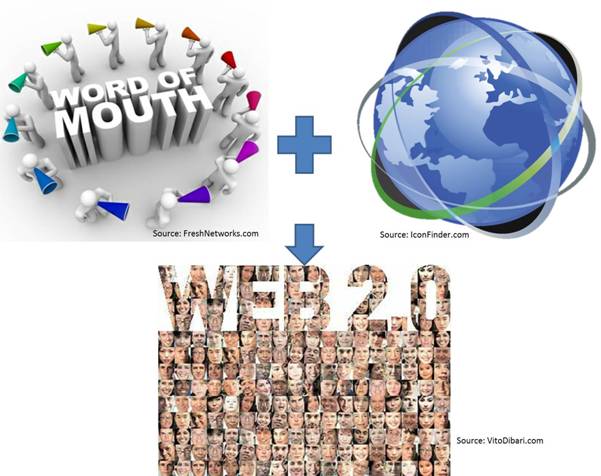
With the advent of search engines and social platforms, information can be delivered to a specific set of consumers, allowing this valuable weapon help you grow your business through what we today call search engine optimization, search engine marketing, social media marketing, and content marketing, among others. However, there is flip side to this: Web 2.0 gives the classic “Word of Mouth” a whole new definition.

User Generated Content (UGC)

In today’s digital marketing landscape, user generated content (UGC) is considered to be an important decision-making factor apart from all other marketing efforts. The logic is very simple: A team of marketers simply cannot create enough information on limited channels to create visibility.

On the other hand, you incentivize the consumer and he, in return, will carry out all your publicity. Now, this was the ideal scenario. Looking at the exact opposite, a consumer who is very unhappy with an expensive product he bought through your company will also react in the very same way. You can also have competition doing the exact same thing (i.e. trying to portray your brand in a bad light) to capture your market.

There is nothing like a business incurring huge losses due to bad reviews on the Internet by a disgruntled ex-employee of the company. For many companies, its monetary value lies in the brand it has created over time. This value gets associated through all its stakeholders, esteemed employees, products, and services. Studies in marketing research show that one happy customer tells three friends, while one UNHAPPY customer tells 3,000. This is one trait, we humans are exceptionally good at.

What is the impact of all this online? Your brand gets a negative vote of trust which in turn drives down its ROI. In addition, negativity added on the Internet will always stay on the Internet.

Source: Reuters.com & Greysunwebdesign.com

Is there a way to tackle all this?

The solution in this dynamic consumer-driven marketing landscape is an evolving field called ORM (Online Reputation Management). Reputation Management has close ties with SEO and SMM in today’s digital marketing strategy. SEO and SMM create and capture user intent, while ORM helps convert this intent into a sale.

Reputation Management is essentially an art, wherein the ulterior motive is to promote and increase positivity for a brand/person on the SERPs usually for a small set of brand keywords that can have a massive influence in the buying cycle of a consumer.

This again needs to be done taking into consideration various factors of Google’s and various other search engines’ algorithmic changes. Another aspect of ORM is that while it helps eradicate negativity from the viewing glasses of a consumer, it additionally helps promote the brand along the way. So looking at it, ORM is not just a tool to be used in crisis situation, but as a long-term strategy for safeguarding the brand value of a company.

History is witness to encounters where proper reputation management has prevented major losses in business by showcasing all the various efforts being undertaken by the company.

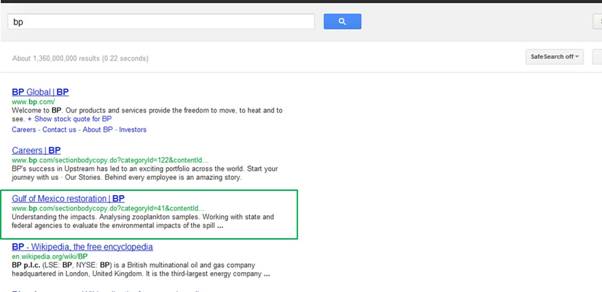
In 2010, when the Deepwater Horizon oil spill occurred off the Gulf of Mexico, it was the focus of every major environmental agency to completely tarnish the reputation of British Petroleum.

Over time, BP has undertaken major efforts to protect and conserve the environment and all this has been effectively portrayed on the Web, and if you perform a search of “BP” on Google the results that appear will be quite evident of this:

BP has not stopped over here. It went ahead to sponsor the 2012 London Olympics with the message of protecting and reducing its impact on the environment. All of this as a proactive measure to ensure that its brand value stays protected over time.

Along with brands and companies, a lot of unverified negative chatter is posted online about businessmen, entrepreneurs, and celebrities alike. Tackling this issue requires another kind of strategy within ORM, where the focus is not limited to cleaning up SERPs but also moderating Google’s Auto-Suggest results and, at the same time, cleaning up Fake Social Profiles that keep on cropping up on major social platforms.

As digital marketing keeps on growing, user-generated content keeps on increasing. Websites thrive by cumulating this negative feedback and in turn promote it by citing consumer awareness (accountability of facts here is still unchartered territory). The advent of Web 2.0 has provided the necessity to have ORM as part of digital marketing; Web 3.0 (semantic web) will tend to take this to a whole new level.

So, unless ORM integrates into the entire digital marketing mainframe, going ahead with various marketing initiatives will prove to be a very costly affair.

Muzzammil Bambot

Muzzammil Bambot

Covonix
Muzzammil Bambot works as an Asst. Project Manager at Convonix, an internet marketing firm from India, providing overall digital marketing strategies to many clients, world over. He as a part of Team Convonix strives to educate fellow SEOs and stay-focused on research based SEO. Read more stuff written by Muzzammil on the Convonix Blog
Muzzammil Bambot

@muzzammilb

Follow @muzzammilb
Muzzammil Bambot

+Muzzammil Bambot

Muzzammil Bambot

Latest posts by Muzzammil Bambot (see all)

  • Online Reputation Management for a Changing Digital Marketing Landscape - September 28, 2012

search engine optimisation company uk search engine optimisation consultant

SEO Blog Feeds - What is RSS? What are Feeds?

Subscribe via Email:

Subscribe via Feed Reader:

Feed Formatting Issues?

Does your feed reader have issues with either of the above feeds? If so you can subscribe to our FeedBurner feed

What are Feeds? What is RSS?

This video does a good job describing how feeds work.

Below is similar information, in a boring textual format.

Offline Subscriptions

In the offline world we subscribe to our interests by

  • paying for magazine subscriptions
  • watching TV channels and shows that interest us at the same time each week
  • reading all books created by a favorite author

Online vs Offline

Online individuals and companies create a vast sea of content. Too much content perhaps. To keep up with all the new content every day I could visit SeoBook.com, sethgodin.typepad.com, SearchEngineLand.com, SEOMoz.org, Wolf-Howl.com, and a bunch of other great blogs and news websites.

Or, to keep myself organized, I could subscribe to feeds from all these great sites and access them all from one place. Feeds allow you to subscribe to information you find relevant and useful, and be notified when your favorite websites are updated.

Instead of needing to visit all the above websites every day you could just go to Google (Google Reader or iGoogle), My Yahoo!, or Bloglines and read all the news at any one of these sites. You do not need to visit all 3 sites to read the news. Just pick your favorite one and subscribe to a bunch of your favorite sites. If you are an avid online reader using RSS subscriptions to keep track of the news can save you hours a day.

Bonus RSS Tip

  • In addition to subscribing to top blogs you can also subscribe to RSS feeds for news topics. For example, here is a link for the Google News feed on SEO. You can subscribe to other keywords that interest you using the RSS link in the left side of a Google News search result.
  • Other information aggregators, like Google Blogsearch, also provide RSS feeds. You can use RSS feeds to track blogs that link to your site.

Want Access to the Best SEO Feed on the WWW?

Bingo. You got it here...the featured threads feed from our private forums.

Subscribe.

Gain a Competitive Advantage Today

Want more great SEO insights? Read our SEO blog to keep up with the latest search engine news, and subscribe to our SEO training program to get cutting edge tips we do not share with the general public. Our training program also offers exclusive SEO videos.

basic search engine optimisation best search engine optimisation

Friday, 28 September 2012

Google Trends & Insights Now The Same

Google TrendsGoogle has announced they've merged the Google Trends and Google Insight tools into one tool under Google Trends at google.com/trends.

Google said:

Now we are merging Insights for Search into Google Trends, wrapping it all up in a clean new interface to give you a clearer view of what’s on the world’s mind. The new Google Trends now includes features from both products and makes it easier and more intuitive to dig into the data. We’ve updated the line chart and map using HTML5 based Google Chart Tools so you can now load the page on your mobile devices, visualize the results without scrolling, and get Hot Searches not just for the U.S., but also India, Japan, and Singapore.

So there is not that much that is new but they merged two really nice and useful tools into one. Which does make sense to me.

On Google+, Google said it can even offer predictions:

Search data can help reveal all kinds of interesting things - observations (or even predictions!) about events like the Oscars or the Super Bowl, popular Halloween costumes or holiday gifts, relative interest in political candidates or parties - you name it.

Forum discussion at Google+ & WebmasterWorld.

search engine marketing company uk search engine marketing consultant

B2B Marketing Innovation: What B2B Marketers Can Learn From Cartoons with Tom Fishburne

Customer preferences for information discovery, consumption and engagement have evolved in a way that requires marketers to adapt. In particular, B2B marketers have had to find new and innovative ways to communicate with customers over long sales cycles filled with digital distractions from smartphones, tablets, computers and other connected devices.  Content types are equally diverse and can range from videos to white papers to infographics and even cartoons.

Tom Fishburne is the Founder and CEO of the wildly popular Marketoonist and in this interview, he’ll share a sneak peek into his B2B Marketing Forum presentation, the importance of storytelling, deciding on visual content and his prediction on the future of B2B Marketing and innovation.

We’re big fans of your work!  Please describe how you become a “Marketoonist”.  Did your journey really start with doodling on business cases at Harvard?

Thanks! Harvard Business School isn’t exactly a feeder school for cartoonists.  I’d dreamed of being a cartoonist when I was a kid, but I’d let it go.  In business school, I started doodling again on the backs of business cases, then in the school paper, and pretty soon professors started asking me for cartoons to use as teaching aids.

I knew that cartoons were powerful communication devices, but I never saw cartooning as a potential career, so I worked in marketing after business school, at General Mills, Nestle, and Method Products.  I kept drawing cartoons on the side, sending them once a week to my marketing co-workers in a simple email newsletter.  Ten years later, my marketing cartoon reaches over 100,000 readers a week.

I thought about submitting cartoons to the New Yorker and the Wall Street Journal, which are two of the main cartoon markets.  But then, the Wall Street Journal contacted me.  They asked if I could create a 20-page cartoon book to help communicate with their readers on how to get the most out of the Journal.  It dawned on me that my unique combination of marketer and cartoonist (Marketoonist) could be valuable to others.

Two years ago, I started Marketoon Studios full-time to develop cartoon-based content marketing campaigns.  I work with a variety of B2B companies, including Oracle, Vodafone, Kronos, and Guidance Software to help them connect and engage with their audiences, using the unexpected medium of cartoons.

What are you most excited about when it comes to B2B marketing?

There has never been a better time to work in marketing. The shift in the role of marketers as publishers is particularly exciting, because it elevates our role to become thought leaders, rather than just pitching features and benefits and parroting our single-minded propositions.

At the MarketingProfs B2B Marketing Forum next week you’re presenting “Content Worth Sharing: What B2B Marketers Can Learn From Cartoons”. What are 2-3 of the most important takeaways from your presentation? What can people attending expect to learn?

With all of the technology at our disposal as marketers, we sometimes forget the value of the big marketing idea. Technology is only as valuable as the marketing ideas that the technology enables.  We can’t make an antisocial experience social just by adding social media.   Technology can’t save a boring idea, but it can amplify a remarkable one.  The impetus is on marketers to create marketing worth sharing.

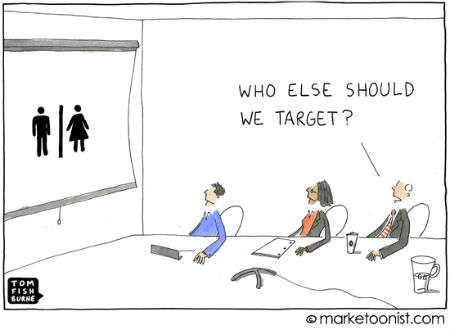
Another main point is the power of preaching to the choir.  It’s a misnomer that to be a big organization, we have to try to talk to everyone in our marketing.  One size actually fits none.  The more niche we get in our communication strategy, the more powerful the bond we create with our audience.  It’s better to be deeply appealing to a few than blandly appealing to the great majority.

Target Market - Marketoonist

One of my favorite sayings in marketing/sales is “Facts tell, stories sell”. What advice can you share about the importance of storytelling with B2B marketing?

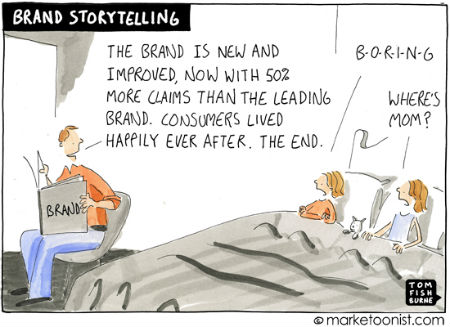
I completely agree with that sentiment.  Features and benefits are boring.  There is no longer a captive audience in marketing.  Without a story, it is easier than ever for our audiences to tune out our messages altogether.  In B2B marketing in particular, brand communication is frequently fact and feature-based.  There is a tremendous amount of power in telling stories when everyone else is telling facts.

Brand Storytelling - Marketoonist

The growing appeal of visual content has provided B2B marketers even more opportunities to attract, engage and convert prospects to customers across the buying cycle. What advice can you give companies that are trying to decide what kind of visual content or media is right for them and their target audience?

I think of visual content as Trojan horses.   It’s most important that it breaks through the clutter and that the audience lets it in.  This means it can’t come off as an advertorial.  But it’s also key that it convey some meaning about your brand.  With our marketoon campaigns, the topics that we parody in a cartoon somehow link so the problems that that brand is trying to solve.  The brand proposition for Kronos is that “workforce management doesn’t have to be so hard”.  So every marketoon parodies situations where workforce management has historically been “hard”.  The audience sees the humor in the situations, and the Kronos brand comes along for the ride.

Developing a solid B2B marketing plan takes research, an understanding of customer goals, pain points and journey.  What are some of the most common myths or mistakes you’ve seen with B2B marketing planning?  Any tips on how to be more successful?

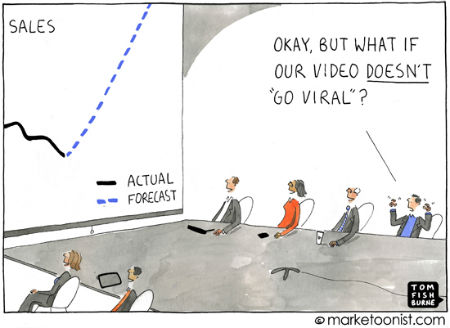
Don’t be a one hit wonder.  Many businesses take a “Flock of Seagulls” approach to B2B marketing.  They create one piece of media and hope that it “goes viral”. If it doesn’t, they often give up.  The web is full of “social media ghost towns” from B2B brands that have given up.  What’s far more important than virality is continuity.  Commit to the long haul in how we connect and engage with our consumers, rather than the one-off campaign.

Go Viral - Marketoonist

With all the hype in the business marketing media, it’s tempting for companies to chase trending B2B marketing tactics. What tips can you share that will help marketers convince management on the importance of creativity, experimentation and innovation? 

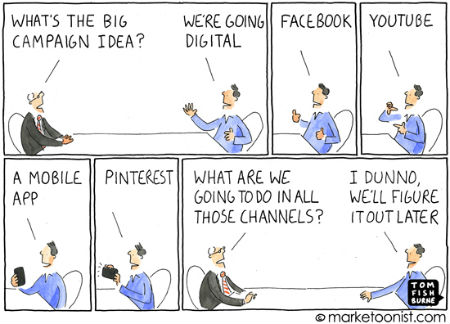
Chasing the shiny new thing is a real challenge for marketers.  It feels sometimes like the tail is wagging the dog.  Many campaigns are built around the tactic of the week, as if the tactic alone was the big idea.  The advice I would give marketers is to stay focused on the big ideas, and remember that the tactics are enablers to those big ideas.  Creativity and experimentation are needed to bring the big ideas to life.  That’s a better sell to management, and ultimately leads to better executions with customers too.

Go Digital - Marketoonist

Any predictions on the future of B2B marketing and the role of visual content?

I think that B2B marketing will become much more interesting in the future as we move beyond the hype of new technologies, and focus more on the big ideas that can be enabled by those technologies.  We can engage with our customers in more meaningful ways.  Technology amplifies great marketing.   I think that visual content will play an increasing role in the marketing we want to amplify.

Please share a tip on how companies can be more innovative with their B2B marketing efforts.

Whether B2C or B2B, the most important shift in marketing is that brand communication is no longer a one-way command-and-control megaphone.  It’s a conversation.  Don Draper is no longer in charge of our brands.  Our audiences are in charge.  So the best inspiration for our marketing efforts comes from our audiences themselves.  Our goal should be, not to market how awesome our products and services are, but figuring out how to make our audiences more awesome.

Thank you for your insights Tom!

If you’re looking for even more insight on making your business more innovative,  be sure to attend Tom’s solo presentation at B2B Marketing Forum “Content Worth Sharing: What B2B Marketers Can Learn From Cartoons” Friday, October 5th at 8:15am.

Sadly, this is the same time as my Track Keynote on Integrating Search, Social and Content across they Buying Cycle but regardless of which presentation you see, you’ll get great info . This is why you should bring 2 or more people to the B2B Forum, so your team can attend multiple sessions scheduled at the same time!

We’ll be releasing a B2B Marketing Innovation eBook on Friday 9/28 that’s chock full of B2B Marketing Innovation tips from marketing champions like IBM, SAP and Silverpop, so be sure to check back!


professional search engine submission search engine keyword promotion

Yahoo's New Contextual Ad Program Launches

Yahoo Media.net Contextual AdsYahoo is relaunching their efforts at offering contextual ads at contextualads.yahoo.net.

This has nothing to do with the Yahoo Publisher Network they shut down in 2010. Instead, this program is managed by an outside company named Media.net.

The Yahoo! Bing Network Contextual Ads program enables web publishers to easily and effectively earn advertising revenue. Publishers can now use the Media.net self-serve platform to create and customize ad units that display relevant text ads consisting of sponsored links and ad topics from the Yahoo! Bing Network.

What I find confusing is that Bing still operates their own contextual ad program named ContentAds. Although, I don't hear much of the program these days.

How is this relationship working?

  • Media.net will exclusively manage all technology, business operations and relationships with respect to publishers worldwide for the program.
  • Yahoo! will manage technology, business operations and relationships with respect to advertisers and drive advertiser sales worldwide for the program. Yahoo! will also manage all aspects of network operations to adhere to existing quality traffic standards.

But no, you can't just sign up. This is pretty exclusive to high traffic sites with "premium content."

You can request an invite to sign up at contextualads.yahoo.net.

Here is the official press release on this announcement.

I am not sure why this will work this time.

Forum discussion at WebmasterWorld & DigitalPoint Forums.

ethical search engine optimization expert search engine optimization

B2B Marketing Innovation: Tips On Creating Social Influence in B2B Marketing from Alan Belniak of PTC

Finding a way to influence your prospects, customers, and company advocates is an essential part of doing business in today’s digital world.  Finding different methods of creating influence is essential with complex purchasing processes often present with B2B marketing.

Fortunately, we have the insight of savvy B2B marketers who are out in the field, developing, testing and implementing best practices that are willing to share with our readers here at Online Marketing Blog.

To that end, next up in our series of B2B Marketing expert interviews is PTC’s Alan Belniak.  As Director of Social Media Marketing, Alan focuses on product lifecycle management developing strategy and innovating the right mix of social media tactics to create influence and and value with their business customers.

Please tell us about your role at PTC and the kind of B2B marketing work you’re involved with there.

For those that might not know, PTC is a business-to-business software company that creates software to give our customers a product and service advantage.  Our software is used by many discrete manufacturers and those in the physical goods service industry.  I know, a mouthful, right?  Put another way, though, is that it is a B2B industry, with a long sales cycle, and typically not-inexpensive price points for the software (translation: ripe for content and social media).

At PTC, I head up social media marketing for the company overall, helping colleagues devise and execute on social strategies and plans.  I help uncover the networks and places where the conversations are happening help and participate in contributing to those discussions, and work to drive the information gained back into the company.  I’m excited about showing how social media and content marketing can be used at various points of the marketing funnel and consideration process.

At the MarketingProfs B2B Marketing Forum you’re participating on the “Social Media Influence – Whos’s Got It, How to Find Them, and What to Do Next?” panel.  Please share 3 practical takeaways from your presentation about influence and B2B Marketing.

Influence can be a fuzzy term these days.  Paul Gillin and I will be showing people what really is influence – and that applies to online and offline, how influence in the business sense is different now than how we might have traditionally viewed it (and what that means to a practitioner), and review some tools on how to go about assessing it and measuring some of that online influence.

Speaking of influence, what’s your take on tools for determining influence?  Klout, Traackr and Kred?  What role should tools like these play in assessing influence and can you recommend others?

I think the tools are just that: tools.  They are not the answer.  They are a number.  Look at it this way: the temperature isn’t the weather.  The temperature is a number that starts to tell the greater story – the weather.  Along with that, you need humidity, a forecast, pressure… you get the idea.  Trying to determine influence by looking only at one number is a fool’s errand.  I think the better approach (and readers can attend the session to learn more) is to use this as one piece of many in terms of understanding influence.  It’s a directional indicator, but it shouldn’t be used as the only waypoint.

The digital marketing world with social media, big data and mobile has created a more complex environment for marketers and their approach in attracting, engaging and converting prospects to customers.  What are some of the B2B marketing strategies you’ve had the most success with in 2012?

We’ve had some success with our SlideShare channel.  Like many B2B companies, we produce a lot of content in PowerPoint.  We came to the realization that if we scrub this a little bit to make it more public-facing, we think that prospects and customers might find this useful.

We’ve also loaded up some ebooks and other .pdfs to SlideShare as well.  What’s interesting is that some of this content is also available on our website.  And some of the content on SlideShare gets more attention that on our website.  So, in a nutshell: put the content where the customers are.

Developing a solid B2B marketing plan takes research, and understanding of the customer goals, pain points and journey.  What are some of the most common myths or mistakes you’ve seen with B2B marketing planning?  Any tips on how to be more successful?

One trap I think some fall into is “shiny object syndrome”.  That is, following the press and online news, and seeing a ton of coverage about the next biggest thing, and thinking it’s a requirement to implement.  Here’s an example: Pinterest is one of the top traffic generators to many sites these days (myriad data supports this).  But is it applicable to all businesses?  For many B2C businesses like fashion and food – it sure is!  What about a funeral parlor?  A document-shredding company?  Is this really a good use of time?

There’s a great line in the movie Jurassic Park that sums this up.  Dr. Ian Malcom (played by Jeff Goldblum) says to John Hammond (Richard Attenboroogh), as they narrowly escape death: “You spent all this time asking yourself ‘if you could’, when you should have spent a little more time asking yourself ‘if you should.’”

One tip when developing the plan is to conduct a social media and audience audit.  That is, spend some time searching for non-branded SEO-like terms in your space.  See where the conversations are happening – good, bad, and otherwise.  I call this a listening exercise.  The key is to track where people are saying the things they are saying.  This will help you determine where you should spend your future time, as well as where not to spend it.  And this isn’t a one-person activity (though it could be).  We’ve done this successfully with a handful of people, and with a little bit of time every day for about two weeks.  The read out of the results has always been interesting and enlightening.

With all the hype in the business marketing media, it’s tempting for companies to chase trending B2B marketing tactics like social media and content marketing.  How do you decide what the right B2B marketing tactical mix is for your business?

Similar to above, I think it’s largely dependent where your audience is.  A social media audit/listening exercise will help tell you that.  With that in hand, it’s good to look at industry data – the kind of data that’s available on MarketingProfs and Content Marketing Institute.  Different industries and roles within those industries consume different kinds of media.  Lastly, and really the best method: ask.  When possible, speak with customers and ask them genuinely how they go about getting smarter on a topic, learning, or which factors go into the decision-making process.

There are many resources online and off to leverage for practical and innovative information about modern B2B marketing.  Of those resources, blogs can be particularly useful.  What are your 3-4 favorite B2B marketing blogs?

Social Media B2B is a great resource.  Jeff and Kip produce some really great stuff there.  Scott Brinker’s Chief Marketing Technologist is another good one – not so much tips and tricks, but more high-level thinking.  Jay Baer’s Convince and Convert is a great read as well.  I also like Christopher Penn’s Awaken Your Superhero blog (This is a good mix of theory and application, several times a week. For content, Content Marketing Institute is tops.  Speaking of tops, no good blog roundup would omit TopRank’s Online Marketing Blog. And there are a few others that are good for marketing in general, that can be applied to the B2B context – David Meerman Scott’s WebInkNow, Seth Godin, and Social Media Explorer, to name a few.

Please share your advice for other B2B marketers out there on how they can be more innovative.

Here’s a tip on a non-innovative idea: regurgitating your website or press release.

Instead, focus on three things:

  1. Utility
  2. Share-ability
  3. Remarkability

Is what you are providing useful to me?  Are you breaking new news before others, providing an interactive cost calculator, or helping me compare large sets of complex data quickly?  If it’s useful, I’ll want to spend time with it.  Once you’ve got me hooked, can I share it easily?  Sure, I can copy a URL like anyone else.  Can you embed share chicklets/widgets/buttons right into the thing itself, to reduce the friction of me sharing?  If I achieved a ‘score’ of sorts, can I share that out to my networks to show them what I did?  Does the meta data that goes with the post explain it well enough?  And is it remarkable that others may comment on it, either in your feed or via email afterward, or even in the hallway?  If you can achieve varying levels of these, then you’re innovating in this space.

And how can you determine the content for that idea? Talk to prospects. Ask them what keeps them up at night, trying to figure out.  Chances are, they aren’t the only ones.

Alan, Thanks for your tips on creating influence for B2B Marketing Innovation.

If you’re looking for even more insight on making your business more innovative,  be sure to check out Alan’s panel discussion at B2B Marketing Forum: “Social Media Influence – Who’s Got It, How to Find Them, and What to Do Next?”  Thursday, October 4th at 9:00am.

Also be sure to check out the TopRank session on 360 degrees of optimization with search and social media marketing: “Integrating Content, Search & Social to Optimize the Funnel” – Friday, October 5th at 8:15am.

We’ll be releasing an eBook soon that’s chock full of B2B Marketing Innovation tips from B2B marketing champions like IBM, SAP and Silverpop, so be sure to check back!

What’s your best B2B Marketing Innovation tip?
We would love to hear from you.  Share your best B2B marketing innovation tip and you will have a chance to win two of the best books on content marketing: Content Rules by Ann Handley and C.C. Chapman and Optimize by Lee Odden (hey, that’s me!).


free search engine optimization tool free search engine submission
5 Ways to Succeed at Global PPC

Pay-per-click or PPC is one of those tried-and-tested marketing strategies that can get fast results. However, two-thirds of international businesses are failing to take advantage of it, according to the World Federation of Advertisers. Is yours one of them?

Global marketing offers great opportunities to companies and entrepreneurs. The competition for keywords is lower, with numbers of potential customers increasing by the day. No nation wants to be left behind in the race to get connected. E-commerce is booming in some of the world’s most populated countries, including India, Russia, and Brazil.

As far as language use on the Internet goes, the days of English-language dominance are long gone. While Internet World Stats’ Top 10 Languages in the Internet shows Chinese to be fast gaining on English, the figures for growth over the last decade are even more interesting. Arabic has grown much faster than English between 2000 and 2011, with a 2,501.2 percent increase in use compared to 301.4 percent. Russian has also made impressive gains.

Semiocast’s statistics on social media usage by language (Twitter specifically) reveal a similar story: Brazil, Japan, and Indonesia are among the world’s most active nations—and their numbers are growing.

If you are looking to explore new markets, there has never been a better time. Here are a few strategies to keep in mind as you launch your global PPC campaign:

1. Research Your Keywords

No matter which part of the world you are marketing to, you need great keywords. What are you selling? It has to be clear to both humans (who may have limited or no English) and to those search engine bots.

Research is vital here. Know the correct translations for your product or service in whatever language you are dealing with. Also identify which keywords and phrases stay in English when used in foreign languages—technical terms in particular don’t always translate.

Watch out especially for ‘false friends’ here, for example ‘Gift’ when used in German actually means poison. Native speaker input will ensure your chosen keywords are not just correct, but also reflect the most current usage.

2. Identify the Key Search Engines

Google, Yahoo!, and Bing? Not necessarily. While these search engines are now geo-targeting their results in different countries in a bid to be ‘local’, other search engines still carry weight in their own regional territories.

If your potential customers in Japan are using Infoseek Japan, or the Hindi-speaking population you want to reach in India has a preference for Raftaar.in, you need to rank in those search results. Similarly, you can’t afford to ignore Baidu if you want to connect with China—it has by far the largest market share.

3. Stand Out (For the Right Reasons)

Even if the competition is less fierce in many regional markets, you still need to get the edge. Bland copy doesn’t cut it in any language. Give readers a reason to want to learn more about your product or company.

Professional copywriting services from native speakers can be well worth the investment here. This inside knowledge will also help you to make the most of what’s happening right now in your target country. Tie your PPC campaign to hot topics to stir up maximum interest.

Obviously, you want to grab attention in your overseas markets for the right reasons. Avoid offending foreign-language Internet users by being aware of their social and cultural values. For example, the informality that creates a friendly impression in the United States or Australia could get you off on the wrong foot in Korea, Japan, or the UAE.

4. Focus on Conversion

Getting overseas Web users to click is only part of the story. If you want customers rather than browsers, you need to focus on converting those clicks into sales.

What do your potential customers see when they click on a link? Make sure the landing page is in their language. Again, remember the culturally appropriate language and images. Once you’ve caught someone’s interest, the last thing you want them to do is hit the back button.

Also localize your content to make it as user-friendly as possible. If you are selling, then using your customers’ currency is a must. Consider what else needs to be local—business hours, holidays, and country dialing codes are just some examples. A site that’s relevant to your customer helps to inspire trust.

5. Monitor and Adapt

Finally, remember the time-worn formula: apply, rinse, and repeat. In PPC terms, this translates to putting your campaign into action, monitoring the results, and repeating what works. At the same time, be ready to ditch what doesn’t.

PPC can be a budget-friendly way of advertising internationally and discovering what’s effective for foreign-language markets. Use the data on click-through and conversion rates to inform your decisions, and with each PPC campaign, you should see better results.

Christian Arno

Christian Arno

Lingo24
About The Author: Christian Arno is the founder of Lingo24, a leading translation company in US. Launched in 2001, Lingo24 now has over 170 employees spanning three continents and clients in over sixty countries. In the past twelve months, they have translated over forty million words for businesses in every industry sector, including the likes of MTV, World Bank and American Express. Follow Lingo24 on Twitter: @Lingo24.
Christian Arno

+Christian Arno

Christian Arno

Latest posts by Christian Arno (see all)

  • 5 Ways to Succeed at Global PPC - September 26, 2012
  • The Importance of International Mobile Search - August 21, 2012
  • Global Social Media - July 25, 2012

SearchCap: The Day In Search, September 27, 2012

Below is what happened in search today, as reported on Search Engine Land and from other places across the web.

From Search Engine Land:

  • Bing’s Social Sidebar Gains Klout Scores & People Recommendations

    Klout has become the latest social service to be integrated into the new Bing Social Sidebar that was launched earlier this year. Bing says that Klout scores will now appear next to people surfaced in the sidebar, plus Klout’s data will be used to help determine some of the people who show. From Bing’s post: [...]

  • Google Merges Insights For Search With Google Trends

    Google has merged two of its popular search/keyword research tools. Google Insights for Search has been absorbed by Google Trends; the combined tool keeps the Google Trends name and exists at the www.google.com/trends address, too. If you try to access the Insights for Search address (www.google.com/insights/search), Google redirects you to the new Google Trends. When [...]

  • The Google Dance: Google’s Eric Schmidt and PSY Dance “Gangnam Style”

    Technology news site The Verge shared a photo and video of Google chairman Eric Schmidt doing the “Gangnam Style” dance while visiting Korea this week. He took a break from his tour of East Asia where he is launching the Nexus 7 to meet the PSY – the rapper behind the record-breaking viral YouTube hit. [...]

  • Last Call – SMX East Starts Next Tuesday in NYC; All Access and Free Expo+ Passes Still Available

    Time is running out! Search Marketing Expo – SMX East begins next Tuesday in New York City. Register now to reserve your spot! The search marketing landscape changes almost daily, but your goals don’t. You strive to increase traffic, improve conversions and maximize your ROI. Invest in attending SMX East and you’ll get 3 days [...]

  • Twitter Opens Up To More Crawling, But Do Search Engines Want Its Search Results In Theirs?

    Twitter recently updated its robots.txt file and, though the change opens up millions of pages to being crawled, there’s no guarantee that the main search engines want what Twitter is offering. The Sociable seems to have been the first to notice Twitter’s robots.txt changes, which now specifically allow Google, Bing, Yahoo, Yandex and other bots [...]

  • Google No Longer Passes Search Referrer Data In iOS 6 From Safari Search Box

    Another source of Google search referrer data appears lost. Searches through Google that happen in Apple’s Safari browser’s search box on iOS 6, Apple’s latest mobile operating system, no longer pass along search terms to publishers. For those unfamiliar, “referrer” data is information a browser passes along to a publisher about the last page you were [...]

  • Understanding SEO Friendly URL Syntax Practices

    Poor URL structure is a frequent SEO issue, one that can impair rankings, keep pages out of the search engine indexes, and suck ranking authority from your other pages or even the entire websites. Some content management systems bake poor URL structures right into their websites. Lax rules can be a culprit, for example, not [...]

  • Google Celebrates 14 Years With Special Logo (Here Are The Past Google Birthday Logos)

    Today is Google’s 14th birthday and to celebrate Google has a special animated logo of a cake with 14 candles being eaten up. We have a copy of the Google Birthday logo, aka Google Doodle, on the right side of this page. For the past ten years, Google has posted birthday logos to celebrate their [...]

  • Google Confirms Hidden Benefit Of Authorship: Bonus Links After A Back-Button Click

    Google has confirmed that there’s a hidden benefit to having authorship status: If a user returns to the search results after reading an author-tagged search result for a certain period of time, Google will add three additional links to similar articles from the same author below the originally clicked link. Say what? A couple visuals [...]

  • SEARCH LOLZ: Internal Memes From Googlers Leaked (And Some Are Rather Damning)

    Popular social news site BuzzFeed, has uncovered a stash of images that allegedly leaked from an internal meme generator within Google intranet. The majority of the images appear to be pro-Google and rib at rivals Facebook, Yahoo! and former Google exec Marissa Mayer. All of the images were sent in from a tipster who stated [...]

  • Closing The Loop From Mobile Search To Mobile Payment Systems

    As the adoption of smartphones increases, consumers are becoming comfortable using their smartphones and tablets to buy goods, transfer money and perform many different kinds of financial transactions. A new study by comScore reports 80% of U.S. smartphone owners accessed mobile commerce sites and apps in July (85.9 million total). According to Google’s Our Mobile [...]

  • Google Street View Coming To Google Maps For Mobile, For Both iOS & Android

    Just in time for those on iOS 6 wanting missing Google Street View photography, Google is bringing its street-level pictures to the mobile web version of Google Maps in two weeks. That also means, as best I can tell, these will come to the web versions of Google Maps for Android and other smartphones, too. [...]

Recent Headlines From Marketing Land, Our Sister Site Dedicated To Internet Marketing:

Search News From Around The Web:

Applications & Portal Features

Business Issues

Local, Maps & Mobile

Link Building

Paid Search & Contextual

Searching

SEM Industry

SEO & SEM

how to promote your website how to search engine optimization